
AI & Machine Learning
AI in Finance: How Artificial Intelligence Is Transforming the Financial World
CipherRoot Software10 min read
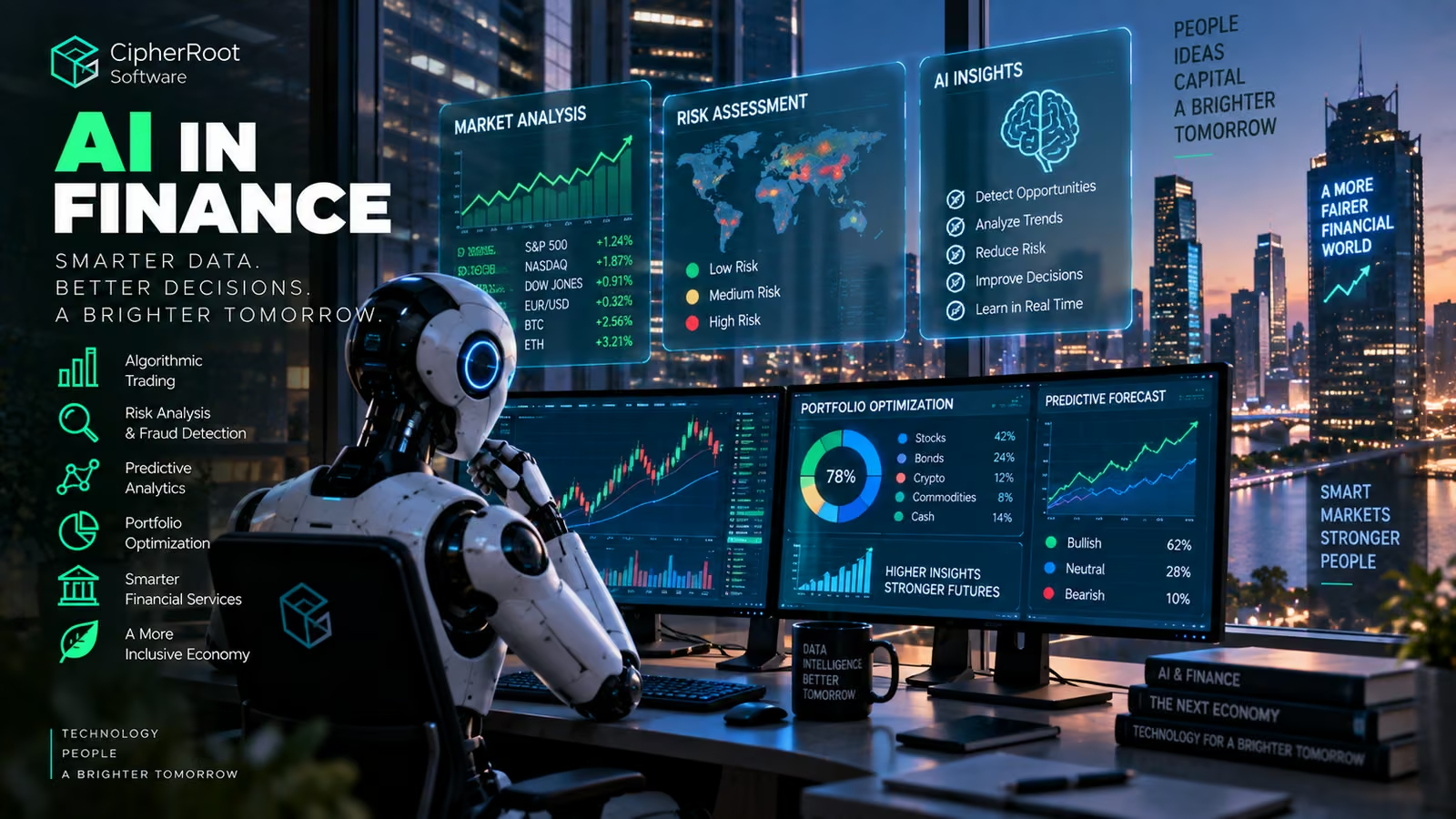
The Financial World Is Becoming Intelligent
Finance has always been driven by information.
Banks analyze transactions. Investors study markets. Businesses monitor cash flow. Insurance companies evaluate risk. Payment systems process millions of financial events.
For decades, computers have helped financial institutions process this information faster.
Now artificial intelligence is taking that process to another level.
AI can analyze enormous datasets, recognize patterns, automate repetitive tasks, detect unusual behavior, and generate predictions based on historical and real-time information.
This is changing the way financial institutions operate.
The future of finance is not simply digital.
It is increasingly intelligent, automated, and data-driven.
What Is AI in Finance?
AI in finance refers to the use of artificial intelligence, machine learning, natural language processing, computer vision, and related technologies across financial services.
These systems can be used for:
Fraud detection Risk analysis Credit assessment Algorithmic trading Customer support Financial forecasting Compliance monitoring Document processing Portfolio analysis Cybersecurity
The goal is not always to automate an entire financial process.
Often, the objective is to help people make better decisions while reducing repetitive work.
AI and Fraud Detection
Financial fraud is constantly evolving.
Suspicious transactions may be hidden among millions of legitimate transactions, making manual analysis extremely difficult at scale.
AI can analyze transaction behavior and identify unusual patterns.
A system could examine factors such as:
Transaction frequency Transaction amount Geographic patterns Device information Account behavior Login activity Historical transaction data
Instead of relying only on fixed rules, machine learning models can identify relationships between multiple signals.
When activity deviates significantly from expected behavior, the system can generate an alert for further investigation.
This makes AI particularly useful as an additional layer of financial security.
Real-Time Risk Analysis
Risk is fundamental to finance.
Banks, insurers, investment firms, and businesses constantly evaluate uncertainty.
Traditional risk analysis often depends on historical data and predefined models.
AI can add another layer of analysis by processing much larger and more complex datasets.
Machine learning systems can identify patterns associated with:
Credit risk Market exposure Operational risk Fraud risk Liquidity concerns Customer behavior
This does not eliminate uncertainty.
Financial markets can change rapidly, and models can be wrong.
AI is therefore best understood as a decision-support tool rather than a machine that can predict the future with certainty.
AI in Credit Assessment
Credit decisions require the evaluation of financial information and risk.
AI can help automate parts of this process by analyzing relevant data and identifying patterns that may help institutions assess applications.
Automated systems can potentially process information faster and provide more consistent initial assessments.
However, financial decision systems need careful oversight.
Data quality, model design, fairness, transparency, privacy, and regulatory requirements all matter.
A faster decision is not necessarily a better decision.
The quality of the underlying system is critical.
Algorithmic Trading and Market Analysis
Financial markets generate enormous amounts of information every second.
Prices change.
Trading volumes fluctuate.
News affects sentiment.
Economic indicators change expectations.
AI systems can process this information at machine speed.
Algorithmic trading systems may use mathematical models and machine learning techniques to identify patterns or execute predefined strategies.
AI can also assist analysts by processing large datasets and summarizing market information.
However, financial markets remain unpredictable.
A model that performs well under one set of conditions can perform poorly when market behavior changes.
This makes testing, monitoring, risk controls, and human oversight especially important.
Predictive Analytics in Finance
Prediction is one of the most attractive applications of AI.
Financial institutions may want to estimate future demand, customer behavior, cash flow, defaults, or other outcomes.
Machine learning models can identify patterns in historical information and use them to produce estimates.
For example, a company could use AI to forecast:
Revenue Customer demand Cash requirements Credit losses Product usage Customer retention
These forecasts are not guarantees.
They are estimates based on available information and model assumptions.
The better the data and the model, the more useful the result can become.
AI-Powered Customer Service
Financial institutions interact with customers across websites, mobile applications, call centers, and messaging platforms.
AI assistants can help answer common questions and automate routine interactions.
A financial AI assistant could help users:
Understand account information.
Find recent transactions.
Navigate financial applications.
Receive explanations of routine services.
Get answers to common support questions.
More advanced systems may eventually provide highly personalized assistance while still operating within strict security and compliance requirements.
The best systems will know when to automate and when to transfer an issue to a human specialist.
Generative AI in Finance
Generative AI is introducing another dimension to financial technology.
Large language models can process and generate natural language, making them useful for tasks involving documents and communication.
Potential applications include:
Summarizing financial documents Drafting internal reports Searching large knowledge bases Assisting analysts Extracting information from documents Generating customer communications Supporting research workflows
Generative AI can dramatically reduce the time required for information-heavy tasks.
But financial information can be highly sensitive.
Systems need strong security, access controls, data protection, and careful validation before AI-generated information is used in important decisions.
AI and Financial Cybersecurity
As finance becomes increasingly digital, cybersecurity becomes increasingly important.
Banks and financial institutions are attractive targets for cyberattacks because they manage valuable information and assets.
AI can help security teams analyze large volumes of security events.
Machine learning systems can identify unusual login behavior, suspicious network activity, unexpected account access, and other anomalies.
AI can also help prioritize security alerts so analysts can focus on the incidents that require the most attention.
At the same time, attackers can use AI to improve their own techniques.
This creates an ongoing technological competition between attack and defense.
Automation and the Financial Workforce
Finance contains many repetitive processes.
Employees may spend significant amounts of time reviewing documents, entering information, reconciling records, creating reports, and checking transactions.
Automation can reduce the amount of manual work required for these activities.
This does not necessarily mean humans become irrelevant.
Instead, employees can spend more time on tasks requiring:
Judgment Communication Strategy Investigation Relationship management Creative problem solving
The nature of financial work may therefore change as AI handles more routine operations.
AI and Wealth Management
Investment and wealth-management platforms can also use AI to analyze financial information.
AI systems can process large datasets and help identify patterns in markets, assets, and customer behavior.
They can potentially assist with portfolio analysis, risk monitoring, scenario analysis, and financial planning tools.
However, financial recommendations involve real-world consequences.
Users and institutions should understand what a model is designed to do, what information it uses, and where its limitations are.
AI can support financial planning.
It should not be treated as an infallible financial oracle.
Personalized Financial Services
Every customer has different financial needs.
AI can help financial institutions analyze customer behavior and provide more personalized experiences.
For example, digital platforms can potentially identify spending patterns and present information that is more relevant to an individual user.
Personalization can make financial services easier to navigate.
But it also raises an important issue:
How much financial data should companies collect and analyze?
Personalization must therefore be balanced with privacy, transparency, and user control.
Data Is the Foundation
AI systems depend on data.
Financial institutions generate enormous quantities of structured and unstructured information.
But large amounts of data do not automatically create good AI.
Data needs to be:
Accurate Relevant Secure Properly structured Carefully governed
Poor-quality data can produce poor-quality results.
This means data governance is becoming just as important as the AI model itself.
The future of financial AI will depend not only on smarter algorithms but also on better data infrastructure.
The Importance of Explainable AI
Financial decisions can have serious consequences.
When an AI system evaluates risk or flags a transaction, organizations may need to understand why the system produced a particular result.
This is where explainability becomes important.
Financial institutions may need systems that can provide understandable reasons for certain outputs rather than simply producing an unexplained score.
Explainable AI can help improve transparency, auditing, debugging, and trust.
The challenge is balancing model complexity with the need for understandable decisions.
Regulation and Responsible AI
Finance is a highly regulated industry.
AI systems used in financial services must operate within applicable legal, regulatory, privacy, and security requirements.
Organizations also need to consider risks such as:
Bias Data leakage Model errors Security vulnerabilities Lack of transparency Poor governance Incorrect automated decisions
Responsible AI is therefore not an optional feature.
It needs to be part of the system from the beginning.
AI Will Not Eliminate Financial Uncertainty
It is tempting to think that enough data and sufficiently powerful AI could make financial markets perfectly predictable.
That is not realistic.
Markets are influenced by human behavior, unexpected events, political and economic developments, technological change, and countless other factors.
AI can identify patterns.
It can analyze scenarios.
It can improve efficiency.
It can support decisions.
But it cannot remove uncertainty from finance.
The smartest financial systems will be built around that reality.
The Future of AI-Powered Banking
Future banking experiences may become increasingly automated.
A customer might interact with an AI financial assistant that can understand natural language, explain transactions, identify unusual account activity, and help navigate financial products.
Behind the interface, AI systems could continuously monitor security, analyze risk, and optimize operational processes.
The customer may see a simple application.
The underlying infrastructure could be an enormous network of intelligent systems working together.
Finance Meets Autonomous Software
One of the biggest changes may be the emergence of software agents capable of completing multi-step financial workflows.
Instead of simply answering questions, AI agents could potentially perform defined tasks within controlled environments.
For example, an enterprise system could monitor financial data, identify a routine reconciliation issue, gather the relevant information, prepare a report, and send it for human approval.
This creates a new model of automation.
The software does not merely provide information.
It performs work.
Strong permissions, audit trails, security controls, and human oversight will be essential as these systems become more capable.
The Future of AI in Finance
The long-term direction is toward financial systems that are increasingly:
Real-time Information is processed continuously rather than only through periodic reports.
Predictive Systems estimate possible outcomes instead of simply describing historical events.
Automated Routine processes require less manual intervention.
Personalized Services adapt to individual needs and behavior.
Secure AI and advanced monitoring are used to detect threats and unusual activity.
Connected Banking, payments, markets, business software, and digital platforms increasingly communicate with one another.
This could create a financial ecosystem that feels almost invisible to the user.
Complexity moves into the infrastructure.
The interface becomes simpler.
Challenges Ahead
The growth of AI in finance also creates difficult questions.
How should institutions manage sensitive data?
How can they validate AI models?
How should automated decisions be reviewed?
What happens when an AI system makes an unexpected error?
How should organizations balance automation with human accountability?
These questions will become increasingly important as AI moves from experimental systems into critical financial workflows.
Technology may move quickly.
Trust must move carefully.
Conclusion
Artificial intelligence is transforming finance by changing how institutions analyze information, detect risks, fight fraud, communicate with customers, and automate operations.
The most important transformation is not that machines are becoming better at calculations.
It is that financial systems are becoming capable of understanding patterns across enormous amounts of information and acting on them at machine speed.
AI will not eliminate financial uncertainty.
It will not replace human judgment everywhere.
And it will not make every financial decision correct.
But used responsibly, it can make financial systems faster, more adaptive, and more intelligent.
The future of finance may therefore be defined by a partnership between human judgment and machine intelligence.
Smarter data. Stronger security. Better decisions. A more intelligent financial world.