
AI & Machine Learning
AI in Environmental Protection: How Artificial Intelligence Can Help Protect Our Planet
CipherRoot Software13 min read
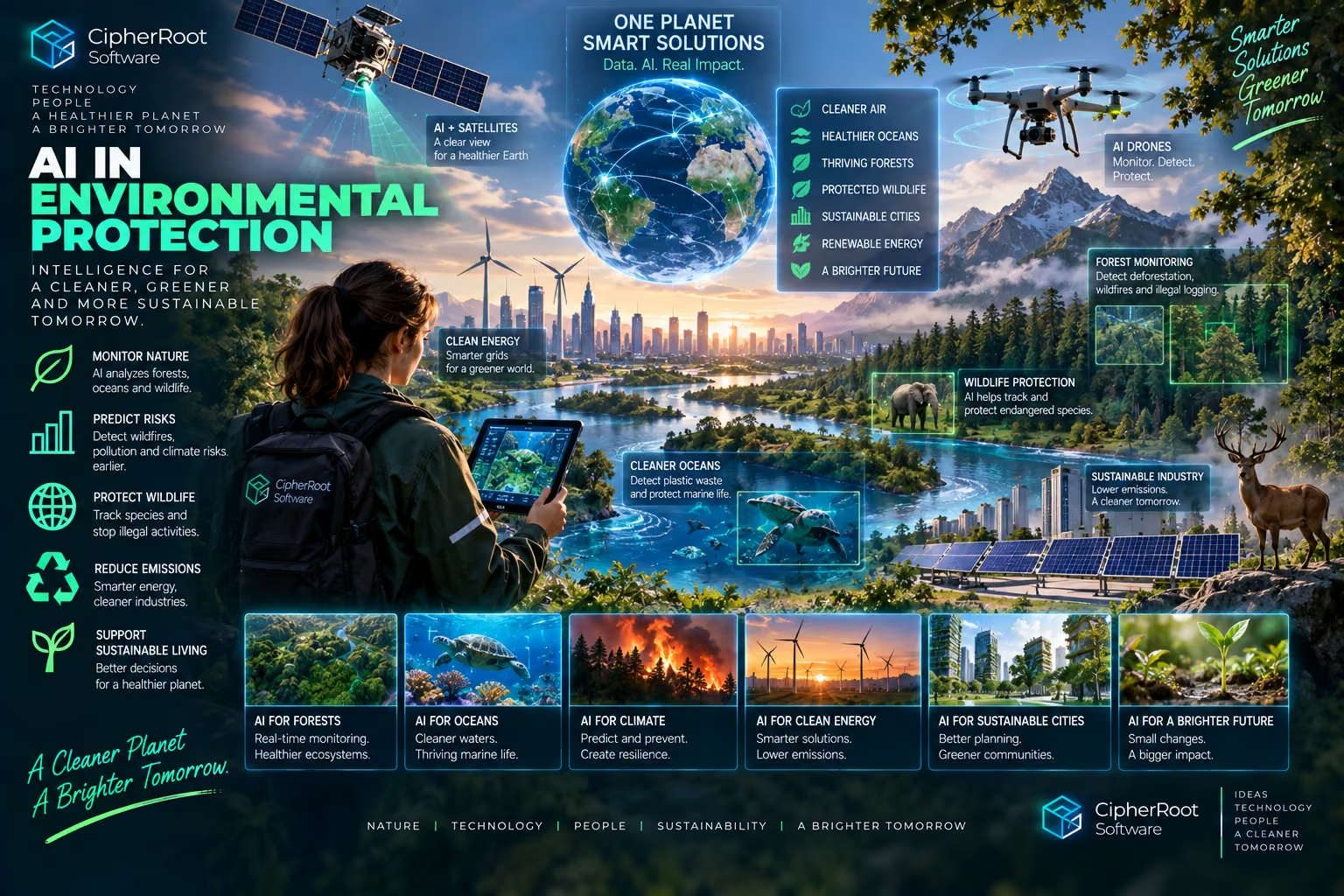
Technology and Nature Are Meeting
Protecting the environment requires understanding what is happening on the planet.
Forests change.
Rivers become polluted.
Wildlife populations move.
Oceans accumulate waste.
Cities produce emissions.
Weather patterns change.
Monitoring all of these systems manually is extremely difficult.
The planet is simply too large and environmental data is too extensive to analyze entirely by people working alone.
Artificial intelligence offers another tool.
AI can analyze satellite images, sensor measurements, weather information, ecological data, and other large datasets to identify patterns and unusual changes.
It cannot solve environmental problems by itself.
But it can help people see problems earlier, understand complex systems, and make better-informed decisions.
What Is AI in Environmental Protection?
AI in environmental protection refers to the use of artificial intelligence, machine learning, computer vision, and related technologies to monitor, analyze, and help manage natural and human-made environments.
Applications can include:
Forest monitoring Wildlife conservation Ocean observation Pollution detection Climate research Renewable-energy forecasting Water management Sustainable agriculture Smart-city planning Environmental risk assessment
The main advantage of AI is its ability to process large amounts of information quickly.
AI and Forest Monitoring
Forests cover enormous areas, making continuous monitoring difficult.
Satellites and drones can capture images of forests over time.
AI can analyze these images and identify changes such as:
Deforestation Wildfire damage Vegetation loss Forest fragmentation Changes in land use
Instead of manually examining every image, environmental teams can use AI to highlight areas that deserve attention.
This creates a faster monitoring process.
Observe → Analyze → Detect → Respond
Early Wildfire Detection
Wildfires can spread rapidly.
Early detection can be critical for emergency response and environmental protection.
AI systems can analyze satellite imagery, cameras, weather conditions, and sensor information to identify signs associated with fires or unusual heat.
A detection system can alert authorities when a potential wildfire is identified.
AI does not stop the fire.
It can help shorten the time between the first signal and human action.
AI and Wildlife Conservation
Wildlife researchers often work with enormous amounts of visual and acoustic information.
Camera traps can capture thousands of images.
Microphones can continuously record sounds.
GPS devices can provide movement information.
AI can analyze this data to identify species and patterns.
A computer-vision model can help classify animals in photographs.
An audio model can help identify species from their calls.
Researchers can then spend more time interpreting the ecological information rather than manually sorting every file.
Monitoring Endangered Species
For endangered species, long-term monitoring is important.
AI can help researchers track:
Population changes Migration routes Habitat use Movement patterns Behavioral changes
This can provide a more detailed understanding of how ecosystems are changing.
Technology can also reduce the amount of manual observation required in difficult environments.
AI and Illegal Wildlife Activity
Environmental protection also involves identifying illegal activity.
Computer vision can help analyze imagery for patterns associated with illegal logging or other unauthorized activity.
Connected sensors can provide alerts when unusual events occur.
AI can help prioritize areas for investigation.
Human authorities remain responsible for verification and enforcement.
The technology provides information.
People make the final operational decisions.
Protecting Oceans With AI
The oceans are difficult to monitor because they are enormous and constantly changing.
AI can assist with the analysis of:
Satellite imagery Marine sensors Water-quality measurements Vessel data Ocean temperature information
These systems can help researchers study pollution, marine ecosystems, and changing environmental conditions.
The ocean is one of the largest data environments on Earth.
AI can help make that data more useful.
Detecting Plastic Pollution
Plastic pollution can be difficult to measure consistently across large areas.
Satellite imagery and aerial systems can provide visual information about coastlines and certain types of marine waste.
AI-based image analysis can help identify patterns and prioritize locations for cleanup or further investigation.
The technology does not physically remove plastic.
It helps improve where and when people look.
Water Quality Monitoring
Clean water is essential for ecosystems and human communities.
Sensors can continuously measure factors such as:
Temperature Turbidity Chemical indicators Oxygen levels Other water-quality parameters
AI can analyze these streams of data and identify unusual changes.
An abnormal pattern can trigger an alert for further investigation.
This can make environmental monitoring more continuous rather than relying only on occasional manual sampling.
AI and Air Pollution
Air quality can change across neighborhoods and throughout the day.
Connected sensors can collect information about air conditions.
AI can analyze these measurements alongside:
Traffic Weather Industrial activity Geographic information
This can help identify pollution patterns and improve forecasting.
Cities can potentially use these insights when planning transportation, industrial activity, or other environmental measures.
Climate Modeling
Earth's climate system is extremely complex.
Researchers analyze information from the atmosphere, oceans, land, ice, and human activity.
AI can assist with certain climate-modeling and forecasting tasks by processing large datasets and identifying complex relationships.
Potential applications include:
Climate pattern analysis Extreme-weather research Forecasting Earth-system modeling Environmental risk analysis
AI does not remove uncertainty from climate science.
It provides additional computational tools for investigating complex systems.
AI for Renewable Energy
Renewable energy production can vary with environmental conditions.
Solar output changes with sunlight.
Wind generation depends on wind conditions.
AI can help forecast renewable-energy production by analyzing historical and real-time data.
This can support:
Grid planning Energy storage Load management Renewable integration
Better forecasts can help energy systems coordinate supply and demand more effectively.
Smart Energy Management
AI can also improve energy efficiency.
Buildings, factories, and cities contain many systems that consume electricity.
AI can analyze patterns in energy use and identify unusual or inefficient behavior.
A smart building may adjust heating, cooling, or lighting according to occupancy and environmental conditions.
A factory may identify equipment that consumes more energy than expected.
The goal is simple:
Use energy where it creates value and reduce unnecessary consumption.
AI in Sustainable Cities
Cities are complex environments.
They contain:
Buildings Roads Public transport Energy networks Water systems Waste systems
AI can help analyze information from these systems.
Applications can include:
Traffic optimization Energy management Waste collection Air-quality monitoring Water management Urban planning
The smart city of the future may use AI to coordinate many environmental systems at once.
Intelligent Waste Management
Waste collection can be inefficient when collection schedules are fixed.
Connected bins can provide information about how full they are.
AI can use this data to help optimize collection routes.
A truck does not necessarily need to visit every location according to a rigid timetable.
Routes can be adjusted according to actual demand.
This can reduce unnecessary travel and potentially improve fuel efficiency.
Sustainable Agriculture
Agriculture depends heavily on environmental conditions.
Farmers need to understand:
Soil moisture Weather Crop health Water availability Pest activity
AI can analyze data from sensors, satellites, drones, and farm equipment.
Computer vision can identify signs of crop stress.
Predictive models can help estimate irrigation requirements.
The objective is not simply greater production.
It is more efficient use of water, energy, land, and other resources.
Precision Agriculture
Precision agriculture uses detailed information to manage fields more precisely.
Instead of treating an entire field identically, farmers can respond to local conditions.
AI can help identify which areas require more water, nutrients, or attention.
This can potentially reduce waste while maintaining productivity.
The exact benefits depend on crop type, equipment, data quality, weather, and farming practices.
AI and Biodiversity
Biodiversity is difficult to monitor because ecosystems contain enormous numbers of species and interactions.
AI can assist researchers in classifying species and analyzing environmental data.
Combined with cameras, microphones, drones, and satellites, AI can help build more detailed ecological records.
This can help researchers understand:
Which species are present?
Where are they moving?
How are habitats changing?
Which areas need closer monitoring?
Environmental Satellites and AI
Satellites provide one of the most powerful tools for observing Earth at global scale.
They can collect information about:
Forest cover Ocean conditions Land use Clouds Fires Vegetation Atmospheric conditions
AI can process these images much faster than manual analysis.
This makes it possible to monitor environmental changes over large regions and across long periods.
The combination of satellite observation + AI analysis is becoming a powerful environmental-monitoring approach.
AI-Powered Drones
Drones provide a closer view than satellites.
They can fly over forests, farms, coastlines, construction zones, and other environments.
AI can analyze drone imagery in near real time.
A drone can potentially:
Detect damaged vegetation.
Identify wildlife.
Inspect difficult terrain.
Monitor water conditions.
Map affected areas after a disaster.
This creates a flexible environmental observation system.
AI and Disaster Response
Environmental disasters can create large and rapidly changing situations.
Floods, wildfires, storms, and earthquakes can affect huge areas.
AI can analyze satellite imagery, weather data, and sensor networks to help identify affected regions.
This can support emergency teams by helping answer:
Where is the damage?
Which areas are changing?
What locations require attention first?
Human emergency teams remain responsible for response decisions.
AI helps process the information more quickly.
Predicting Environmental Risks
Prediction can be as important as observation.
If a system can identify increasing risk before an event occurs, people may have more time to prepare.
AI can help analyze combinations of environmental variables and historical patterns.
Possible applications include:
Flood-risk analysis Wildfire-risk mapping Drought monitoring Pollution forecasting Ecosystem-change detection
Predictions are never perfect.
But earlier information can still be valuable.
AI and Carbon Monitoring
Understanding emissions requires reliable measurement.
AI can analyze information from sensors, satellites, industrial systems, and other sources to estimate or monitor emissions-related patterns.
This can help identify:
Changes in emissions Industrial patterns Energy-use trends Areas requiring additional investigation
Accurate measurement is important because environmental policies and business decisions depend on trustworthy data.
The Importance of Better Environmental Data
AI is only as useful as the data it receives.
Environmental data can contain:
Missing values Sensor errors Geographic gaps Inconsistent measurements Limited historical records
A model cannot magically transform poor-quality information into reliable truth.
This is why environmental AI requires strong data collection and validation systems.
Better sensors + better data + better AI = better environmental insight.
AI Does Not Replace Environmental Science
Artificial intelligence can identify patterns.
Environmental science explains what those patterns mean.
A model may identify an unusual change in vegetation.
Scientists need to determine why it happened.
An AI system may detect a change in water quality.
Researchers need to determine its cause and significance.
AI is therefore a tool within a broader scientific process.
The most effective systems combine:
AI + scientific expertise + field measurements + human judgment
The Risk of False Alarms
Environmental monitoring systems need to manage uncertainty.
An AI model can generate false positives.
A system might report a potential wildfire that is actually harmless.
It might detect a possible animal that is not present.
Too many false alarms can overwhelm environmental teams.
For this reason, AI systems should be calibrated, evaluated, and continuously improved.
Accuracy matters more than impressive demonstrations.
AI and Environmental Decision-Making
Environmental decisions often involve trade-offs.
A new development may provide economic benefits while affecting an ecosystem.
A new energy project may reduce emissions while changing land use.
A city may need to balance transportation, housing, green space, and infrastructure.
AI can help model scenarios and provide additional information.
It should not automatically decide what society values most.
People and institutions still need to define priorities.
Privacy and Environmental Monitoring
Environmental technologies can sometimes collect information about people as well as nature.
Drones, cameras, smart-city sensors, and connected infrastructure may capture images or location-related information.
This means environmental AI also needs privacy safeguards.
A system designed to protect nature should not unnecessarily compromise the privacy of nearby communities.
Cybersecurity for Environmental Systems
Environmental monitoring systems are increasingly connected.
Sensors may communicate with cloud platforms.
Satellites send information to data centers.
Smart-city systems operate over networks.
Energy infrastructure depends on digital controls.
These systems need cybersecurity.
A compromised environmental system can produce false information or disrupt important operations.
Protecting the data is part of protecting the environment.
AI and the Circular Economy
AI can also support more efficient use of materials.
Manufacturers can use AI to optimize production and reduce waste.
Computer vision can improve sorting in recycling systems.
Supply-chain systems can track materials.
Predictive maintenance can extend equipment lifetimes.
These applications support the broader idea of a circular economy:
Use resources efficiently. Extend product life. Recover valuable materials. Reduce waste.
Building Sustainable Infrastructure
Environmental AI can help cities and companies plan infrastructure more intelligently.
Designers can evaluate:
Energy demand Water consumption Transportation patterns Environmental impact Resource use
Digital models can simulate alternative scenarios before physical construction begins.
This can support more informed planning.
The goal is not simply to build smarter infrastructure.
It is to build infrastructure that uses resources more responsibly.
The Future of Environmental Monitoring
The environmental monitoring system of the future may contain many layers.
Satellites observe the planet from above.
Drones investigate specific locations.
Ground sensors provide continuous measurements.
AI analyzes the incoming information.
Researchers interpret the results.
Authorities take action.
The pieces form a connected environmental intelligence network.
A Planetary Early-Warning System
Imagine a future system that continuously observes Earth.
Satellites detect a change in forest coverage.
AI identifies an unusual pattern.
Drones are sent to investigate.
Ground sensors confirm the environmental conditions.
Researchers analyze the data.
Local teams receive the information.
A response begins.
This kind of layered monitoring could make environmental protection more proactive.
Instead of waiting until a problem becomes obvious, systems can help identify potential problems earlier.
AI and Conservation Planning
Conservation resources are limited.
Organizations may need to decide where to focus monitoring, restoration, or protection efforts.
AI can analyze environmental variables and help identify areas that may require additional attention.
This does not automatically determine conservation priorities.
Human experts still need to consider ecological, social, legal, and economic factors.
AI can make the information landscape clearer.
A More Data-Driven Environmental Future
The future of environmental protection will likely combine traditional field science with advanced digital systems.
Researchers will continue collecting measurements in the real world.
Satellites will continue observing Earth.
Sensors will continue producing data.
AI will increasingly connect these information sources.
This creates a new type of environmental workflow:
Measure → Analyze → Understand → Act → Measure Again
The process becomes continuous.
What AI Cannot Do Alone
Artificial intelligence cannot plant a forest by itself.
It cannot clean an ocean by itself.
It cannot create environmental policy by itself.
It cannot replace conservation workers, scientists, engineers, or communities.
AI provides information and computational capability.
People still need to transform that capability into action.
Technology is an amplifier.
The direction still comes from humans.
The Future of AI and Environmental Protection
Future systems may connect AI with:
Satellites
For global observation.
Drones
For local inspection.
Sensors
For continuous measurements.
Robotics
For physical environmental tasks.
Digital twins
For simulation.
Smart infrastructure
For resource management.
Renewable energy
For cleaner power systems.
Scientific computing
For deeper environmental research.
Together, these technologies can create a much more connected picture of the planet.
Conclusion
Artificial intelligence is becoming an increasingly useful tool for environmental protection.
It can analyze satellite imagery.
Monitor forests.
Track wildlife.
Study oceans.
Detect pollution patterns.
Support climate research.
Improve renewable-energy forecasting.
Optimize resource use.
Assist smart-city planning.
And help environmental teams respond to changing conditions.
But AI is not a replacement for environmental science or human action.
The strongest environmental systems combine good data, scientific expertise, intelligent software, reliable infrastructure, and people capable of turning information into meaningful decisions.
The future of environmental protection may therefore look less like a single revolutionary machine and more like a planet-wide network of observation and intelligence.
Satellites watch.
Sensors measure.
AI analyzes.
Researchers understand.
Communities respond.
And the cycle continues.
The technology can help us see the planet more clearly.
What we do with that knowledge is still up to us.
Smarter monitoring. Better decisions. Stronger ecosystems.
AI can help protect the planet by turning more environmental information into earlier insight—and earlier insight into action.