
AI & Machine Learning
AI in Daily Life: How Artificial Intelligence Is Becoming Part of Everyday Life
CipherRoot Software11 min read
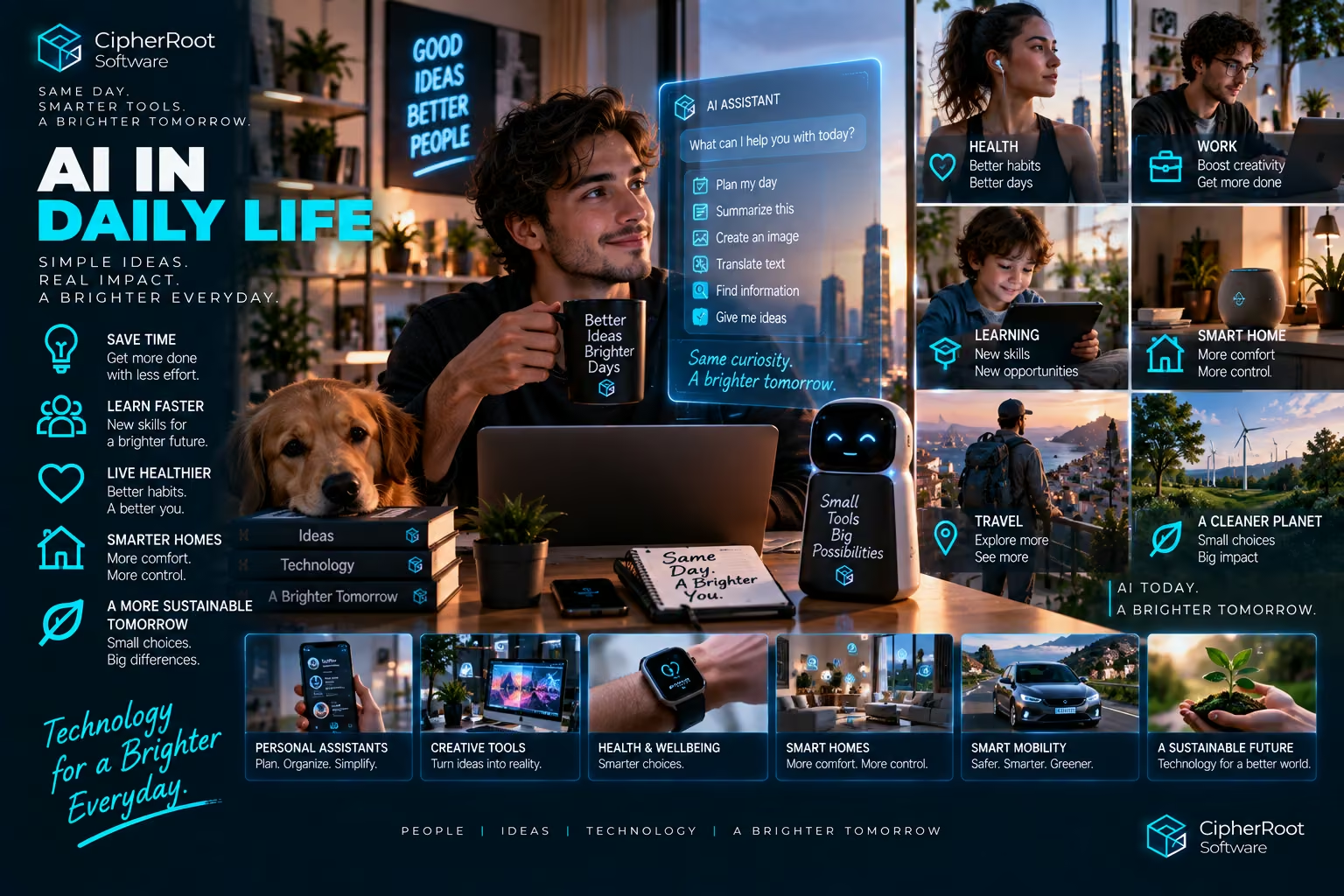
AI Is Already Around Us
Artificial intelligence can sometimes sound like a technology from the distant future.
In reality, it is already part of everyday life.
People use AI when they search for information, receive personalized recommendations, navigate through cities, filter unwanted messages, translate languages, edit photographs, interact with digital assistants, or unlock features on smart devices.
The most interesting part is that many people do not even notice when AI is being used.
It often works quietly in the background.
Instead of appearing as a futuristic machine, AI is increasingly becoming a layer inside ordinary software and connected devices.
The future of artificial intelligence may therefore be less about one giant robot and more about thousands of small intelligent systems helping with everyday tasks.
What Does AI in Daily Life Mean?
AI in daily life refers to artificial intelligence systems that assist people during ordinary activities.
These systems can be found in:
- Smartphones
- Smart homes
- Cars
- Wearable devices
- Search engines
- Online stores
- Social platforms
- Entertainment services
- Education tools
- Work software
Some AI systems generate content.
Others recognize images or speech.
Some predict what a user may want next.
Others automate repetitive tasks.
The technology can be very different from one application to another.
The common idea is that software is becoming better at interpreting information and responding to human needs.
AI Assistants
One of the most visible examples is the AI assistant.
People can now interact with software using natural language instead of relying entirely on menus and buttons.
An AI assistant can help with:
- Planning a day
- Finding information
- Writing text
- Summarizing documents
- Translating languages
- Generating ideas
- Organizing tasks
The interface is changing.
Instead of asking:
“Which menu contains this feature?”
users can increasingly ask:
“Can you help me do this?”
That is a major shift in human-computer interaction.
AI on Smartphones
Smartphones have become powerful AI platforms.
AI can support:
- Camera processing
- Voice recognition
- Photo organization
- Translation
- Search
- Recommendations
- Spam filtering
- Text assistance
Modern smartphones can perform some AI workloads directly on the device.
This is useful because local processing can reduce latency and may reduce the need to send some information to remote servers.
The smartphone is becoming more than a communication device.
It is becoming a personal AI platform.
Smarter Search
Search engines have traditionally returned lists of links.
AI-powered search can increasingly provide summaries, explanations, and conversational interactions.
Instead of manually opening many pages, users can ask a question and receive a structured response.
This can save time when the goal is understanding rather than simply finding a website.
However, AI-generated search summaries can contain errors.
Reliable sources and human verification remain important, particularly when information is important or sensitive.
AI and Social Media
Recommendation algorithms have influenced social media for years.
AI systems analyze interactions and content patterns to determine which posts, videos, or accounts may be relevant to users.
This can create highly personalized experiences.
The same technology can also create challenges.
Recommendation systems can influence what people see and how long they remain on a platform.
This makes transparency and thoughtful platform design increasingly important.
AI is not only selecting content.
It can shape the digital environment through which people experience information.
AI in Photography
Modern cameras rely heavily on computational photography.
AI and machine-learning techniques can assist with:
- Image enhancement
- Noise reduction
- Scene recognition
- Portrait effects
- Object detection
- Automatic adjustments
A photograph taken with a smartphone may already pass through many computational processes before the final image appears.
This means AI is changing photography without requiring users to understand the underlying algorithms.
The camera is no longer just capturing light.
It is processing and interpreting the scene.
AI in Music and Entertainment
Entertainment platforms use intelligent systems to help personalize what users watch or listen to.
Recommendations can be based on:
- Previous behavior
- Preferences
- Similar users
- Content characteristics
- Session activity
Generative AI is also expanding the creative side of entertainment.
AI tools can assist with:
- Music generation
- Image creation
- Video concepts
- Voice production
- Script development
This makes content creation more accessible while also creating new questions around originality, ownership, and authenticity.
AI and Smart Homes
The home is becoming increasingly connected.
Smart lights, thermostats, cameras, appliances, speakers, and other devices can communicate with one another.
AI can help coordinate them.
A smart home may learn patterns such as:
When people usually wake up.
When rooms are occupied.
How the temperature changes.
When certain devices are normally used.
The system can then automate selected routines.
The goal is to reduce the amount of manual control required.
The smartest home may not be the one with the most gadgets.
It may be the one that makes daily life feel simpler.
AI in Transportation
Navigation applications already use large amounts of data to calculate routes and estimate travel times.
AI can help analyze traffic and changing road conditions.
Modern vehicles can also use AI-related technologies for:
- Driver assistance
- Object detection
- Parking assistance
- Navigation
- Voice interaction
- Cabin monitoring
Future transportation systems may combine AI with autonomous driving, connected infrastructure, and real-time mapping.
The car becomes another intelligent computer in the environment.
AI in Shopping
Online stores use recommendation systems to personalize shopping experiences.
A platform may analyze previous purchases, searches, browsing activity, and product relationships.
AI can also assist with:
- Product search
- Customer support
- Product descriptions
- Inventory forecasting
- Fraud detection
For customers, the experience can become more personalized.
For businesses, AI can help process information at a scale that would be difficult to manage manually.
AI in Education
Learning is another area where AI can become a powerful assistant.
Students can use AI tools to:
- Explain concepts
- Practice languages
- Generate exercises
- Review writing
- Summarize material
- Explore questions
Teachers can also use AI for administrative and preparation tasks.
However, education is more than receiving answers.
Students still need to develop reasoning, creativity, communication, and independent thinking.
AI works best when it supports learning rather than becoming a shortcut around learning.
AI at Work
For many people, AI is becoming part of the daily work environment.
Office software can include AI features for:
- Writing
- Summarization
- Data analysis
- Meeting notes
- Research
- Document processing
- Coding
Instead of replacing entire jobs, AI often begins by assisting with individual tasks.
This can reduce repetitive work and help employees focus on more complex activities.
The future workplace may therefore be a combination of:
People + AI assistants + automation + intelligent software
AI in Healthcare
AI is increasingly being used in selected healthcare applications.
Medical imaging, documentation support, research, hospital operations, and monitoring are examples of areas where AI can assist professionals.
The technology can process large amounts of information quickly.
But healthcare requires particularly strong validation, privacy protection, and human oversight.
AI can support healthcare professionals.
It should not be treated as an unquestionable authority.
AI and Personal Health Technology
Wearables can collect information about activity, sleep, movement, and other signals.
AI can analyze these patterns and present them in a more understandable form.
For example, software can identify trends over time rather than showing isolated measurements.
This can help users better understand their own data.
However, consumer wearable measurements have limitations, and health-related conclusions should be interpreted appropriately.
More data does not automatically mean better health decisions.
AI for Communication and Translation
Language barriers are becoming easier to cross.
AI translation systems can process written and spoken language.
This can help with:
- Travel
- International business
- Education
- Customer support
- Online communication
Wearable devices may eventually make translation more immediate by providing it through earbuds or smart glasses.
The long-term goal is not only translation.
It is frictionless communication between people who speak different languages.
AI and Accessibility
AI can also make digital systems more accessible.
Speech recognition can provide alternatives to typing.
Text-to-speech can convert written information into audio.
Computer vision can help interpret images.
Translation systems can support communication.
These technologies can help people interact with digital environments in different ways.
The best applications of AI may therefore be those that remove barriers rather than simply add more features.
AI and Personalization
One of AI's most useful abilities is personalization.
Traditional software often gives everyone the same interface.
AI can adapt systems to individual preferences and behaviors.
A personal assistant can learn preferred routines.
A music platform can adapt recommendations.
A smart home can learn schedules.
A learning platform can adjust difficulty.
Personalization can make technology feel more useful.
But the more personalized a system becomes, the more carefully user data must be handled.
Privacy in an AI-Powered World
AI systems can be extremely useful because they have access to information.
That information can also become sensitive.
A connected device may process:
- Location
- Voice
- Images
- Search history
- Communication
- Behavioral patterns
This creates an important principle:
Useful technology should still respect personal boundaries.
Users need meaningful controls over what is collected and how it is used.
On-Device AI and Privacy
One possible way to improve privacy is processing more information directly on a device.
On-device AI can analyze certain tasks without sending every input to the cloud.
This can provide:
- Lower latency
- Better offline functionality
- Reduced network dependency
- Potentially improved privacy
Not every workload can run locally.
Large models may still require cloud computing.
Future systems will likely combine local and cloud intelligence depending on the task.
AI Can Make Daily Life Simpler
The most useful AI applications may be surprisingly ordinary.
Writing an email.
Finding a document.
Planning a trip.
Translating a sentence.
Adjusting a thermostat.
Finding the right route.
Organizing a schedule.
Creating a shopping list.
Summarizing a long article.
These tasks are not revolutionary individually.
But reducing friction across hundreds of everyday moments can create a significant difference.
AI's impact may therefore be cumulative.
Small improvements add up.
The Problem of Over-Automation
There is also a risk in making everything automatic.
People may become dependent on systems they do not understand.
An automated recommendation can be wrong.
A digital assistant can misunderstand context.
A smart device can fail.
A user may therefore need the ability to override automation.
The best systems should be intelligent without becoming uncontrollable.
Convenience should not remove human agency.
AI Needs Human Judgment
Artificial intelligence can be extremely useful.
It can also be wrong.
This is why human judgment remains important.
People need to know when to trust an AI output and when to verify it.
They also need to recognize situations where AI should not be used at all.
The goal is not perfect automation.
It is appropriate automation.
The Future of Everyday Computing
The future may bring AI into almost every layer of digital life.
The smartphone becomes smarter.
The home becomes more adaptive.
The car becomes more intelligent.
Wearables become more useful.
Work software becomes more autonomous.
Personal assistants become more contextual.
Robots become more common.
AI stops feeling like a separate application.
It becomes infrastructure.
A Day in an AI-Enabled Future
Imagine waking up.
Your smart home has already adjusted the temperature.
Your assistant summarizes your schedule.
Your wearable presents your daily activity information.
You ask your glasses for directions while leaving home.
Your vehicle helps navigate changing traffic.
At work, AI prepares a summary of overnight updates.
You use an AI assistant to research a project.
Later, you translate a conversation automatically.
When you return home, the house adjusts to your routine.
None of these individual technologies needs to feel extraordinary.
Together, they create something different.
A world where intelligence is woven into everyday tools.
The Most Important Change
The biggest transformation may not be that AI becomes more visible.
It may become less visible.
People may stop thinking about AI as a special technology.
They will simply expect software to understand language.
They will expect devices to recognize context.
They will expect systems to adapt.
They will expect automation to work.
Just as nobody thinks about databases every time they open an application, people may eventually stop thinking about AI every time they interact with technology.
It will simply be there.
Conclusion
Artificial intelligence is already changing everyday life through smartphones, search, entertainment, smart homes, transportation, education, healthcare, communication, shopping, and workplace software.
Its most important impact may come from the accumulation of small improvements.
A faster search.
A better translation.
A smarter camera.
A more useful assistant.
A simpler workflow.
A more adaptive home.
The future of AI does not necessarily require futuristic machines everywhere.
It may arrive quietly.
Inside the devices we already use.
Inside the software we already depend on.
And eventually, inside almost every digital interaction.
The real revolution may be the moment when intelligent technology stops feeling futuristic and simply becomes normal.
Smarter tools. Simpler days. Better possibilities.
AI is not just changing technology.
It is changing the way technology fits into everyday life.