
AI & Machine Learning
AI in Architecture: How Artificial Intelligence Is Redefining the Way We Design Buildings
CipherRoot Software11 min read
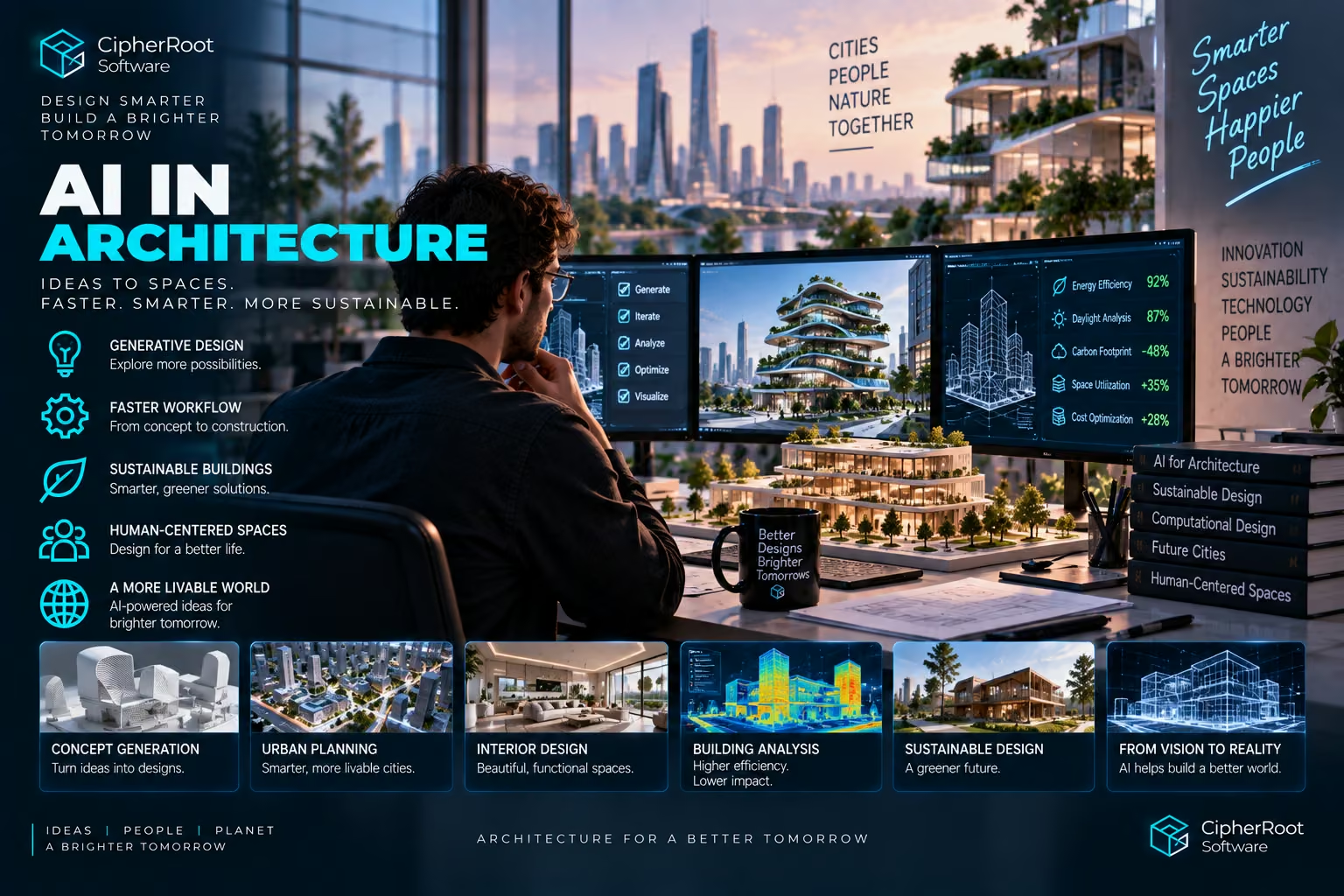
Architecture Is Entering a New Digital Era
Architecture has always been a combination of creativity, engineering, culture, and technology.
Architects use drawings to communicate ideas.
Engineers calculate structures.
Designers study materials, light, space, and human movement.
Computers have already transformed many of these processes.
Now artificial intelligence is taking architecture into another stage.
AI can generate design alternatives, analyze building performance, study urban environments, automate repetitive tasks, and help architects explore possibilities much faster.
The goal is not to replace the architect.
It is to give architects more ways to think, test, and create.
What Is AI in Architecture?
AI in architecture refers to the use of artificial intelligence and related computational technologies throughout the design and construction process.
Applications can include:
Generative design Building-performance analysis Energy optimization Computer vision 3D visualization Urban planning Space planning Construction monitoring Project documentation Predictive analysis
Some systems focus on one specific task.
Others connect multiple stages of the architectural workflow.
This creates the possibility of moving from isolated digital tools toward an integrated intelligent design process.
Generative Design
One of the most interesting uses of AI is generative design.
Traditional architectural design often begins with an idea that is gradually refined.
Generative systems can approach the process differently.
An architect can define constraints such as:
Site dimensions Floor area Orientation Sun exposure Circulation Structural requirements Environmental goals
AI can then explore multiple possible solutions.
The architect can review those alternatives and select or refine the directions that make the most sense.
This changes the role of computation.
Instead of calculating one design, software can help explore an entire design space.
AI Does Not Replace Architectural Vision
Generating options is not the same as creating a meaningful building.
Architecture is about more than geometry.
It involves:
Culture
Human behavior
Context
Materials
Light
Emotion
Function
Structure
AI can generate forms, but architects still need to decide what those forms mean and whether they belong in a specific place.
The strongest workflow is therefore collaborative.
AI expands possibilities.
The architect provides intention.
Faster Concept Development
Early-stage design can involve many iterations.
An architect may spend hours creating variations of a facade, floor plan, interior layout, or massing study.
AI-assisted tools can speed up this experimentation.
A designer can explore different concepts without rebuilding everything from the beginning.
This does not necessarily reduce creativity.
It can reduce the cost of trying something new.
When experimentation becomes faster, architects can test ideas that might otherwise have been rejected simply because they required too much time to explore.
Building Performance Analysis
A building needs to perform, not just look good.
Architecture involves questions about:
Energy use Natural light Ventilation Thermal comfort Material efficiency Occupancy Environmental conditions
AI can analyze large amounts of building-related information and help identify patterns.
For example, computational systems can compare design alternatives based on expected energy or daylight performance.
This allows performance considerations to enter the design process earlier.
Instead of asking only:
“Does this building look good?”
architects can also ask:
“How does this building behave?”
AI and Sustainable Architecture
Sustainability has become an increasingly important part of architectural design.
Buildings consume materials and energy throughout their lifecycles.
AI can help designers explore ways to improve efficiency.
A design system might compare alternatives based on:
Solar exposure Energy demand Material quantities Window placement Building orientation Shading Ventilation strategies
The technology does not automatically make a building sustainable.
It provides more information for making informed design decisions.
The architect still decides which trade-offs are appropriate.
Smarter Building Orientation
Orientation can influence how a building interacts with sunlight, wind, and the surrounding environment.
AI-based design systems can evaluate multiple orientations and configurations.
A building may be tested under different environmental conditions before the design is finalized.
This creates a more analytical approach to early architectural planning.
Instead of relying only on intuition, designers can combine experience with computational evidence.
AI and Interior Design
Artificial intelligence can also support interior architecture.
Designers can experiment with:
Furniture layouts Lighting concepts Material combinations Color palettes Spatial organization Different visual styles
Generative image tools can produce rapid concept visualizations.
This allows clients and designers to discuss possibilities earlier.
A rough idea can become a visual concept within minutes.
The final space still requires professional judgment, but the communication process becomes much faster.
Urban Planning and AI
Architecture does not exist independently from the city.
Buildings interact with roads, public spaces, transportation systems, energy infrastructure, and neighboring structures.
AI can analyze large urban datasets to help planners understand:
Traffic patterns Population changes Land use Infrastructure demand Green-space distribution Environmental conditions
This creates new possibilities for urban simulation.
Instead of evaluating one scenario at a time, planners can model multiple alternatives and study their potential effects.
Digital Twins for Buildings
Digital twins can create dynamic digital representations of physical buildings.
A building twin can contain information about:
Structure Mechanical systems Energy usage Occupancy Sensors Maintenance Environmental conditions
During design, the digital model can help simulate the building.
After construction, it can continue to support monitoring and management.
This creates a connection between architecture and long-term building operation.
The digital model does not disappear when construction ends.
It can continue evolving with the physical building.
AI and Construction
Artificial intelligence is also entering the construction phase.
Computer-vision systems can analyze images and video from construction sites.
Software can help monitor progress and identify certain inconsistencies between planned and observed conditions.
AI can also assist with:
Scheduling Material planning Risk monitoring Progress tracking Document processing
Construction remains a highly physical and unpredictable industry.
AI therefore works best as an additional information and coordination layer rather than as a complete replacement for people on site.
Predictive Maintenance
A building continues to generate information after it is occupied.
Sensors can monitor:
Temperature Energy consumption Equipment performance Air quality Mechanical systems
AI can analyze changes in these patterns.
An unusual increase in energy use, for example, may indicate that a system needs investigation.
Predictive maintenance can help building managers move from:
Repair after failure
toward:
Identify potential problems earlier
This can improve operational planning and reduce unexpected interruptions.
AI and Structural Design
Structural engineering involves balancing strength, materials, cost, safety, and geometry.
Computational optimization can explore many possible structures within defined constraints.
AI-assisted systems can help engineers investigate:
Structural layouts Material efficiency Load distribution Geometry Design alternatives
However, structural safety cannot simply be delegated to a generative algorithm.
Engineers remain responsible for validation, calculations, standards, and professional judgment.
AI can assist exploration.
It cannot replace accountability.
Visualization Becomes More Powerful
One of the most visible benefits of AI in architecture is visualization.
An idea that exists only as a sketch can quickly become a detailed visual concept.
Designers can explore different:
Materials Lighting conditions Landscapes Facades Interiors Architectural styles
This can improve communication between architects, developers, engineers, and clients.
People often understand a visual concept faster than a technical drawing.
AI can make the visualization process significantly more flexible.
From Sketch to Digital World
The traditional path might be:
Sketch → CAD → 3D Model → Render
AI-assisted workflows can introduce more possibilities:
Idea → Text → Image → 3D Concept → Simulation → Refinement
This does not mean every architectural project will follow the same workflow.
But it demonstrates how the boundary between conceptual design and digital modeling is changing.
An idea can move through multiple representations much faster.
AI and Parametric Architecture
Parametric design already allows architects to define relationships and rules that control geometry.
AI can work alongside these systems.
Instead of manually adjusting every parameter, an intelligent system can help explore combinations that satisfy multiple objectives.
For example, a design may need to balance:
Aesthetics + daylight + energy + structure + cost
These objectives can sometimes conflict.
AI can help explore the trade-offs.
The architect decides which balance is appropriate.
Human-Centered Architecture
Technology should never become the only priority.
Buildings are designed for people.
People experience spaces through movement, sound, light, scale, material, temperature, and emotion.
AI can analyze data.
It cannot automatically understand every cultural or emotional dimension of a place.
That is why human-centered design remains essential.
The most intelligent building is not necessarily the one with the most technology.
It may be the one that serves people most effectively.
Architecture and Accessibility
AI can also support more accessible architectural design.
Computational tools can help evaluate circulation, spatial layouts, and environmental conditions.
Design teams can simulate different user scenarios and identify potential obstacles.
Accessibility should not be treated as an afterthought.
It can be integrated into the design process from the beginning.
Technology simply provides more ways to test whether a space works for different users.
The Risks of AI-Generated Architecture
AI-generated designs can create impressive images quickly.
But visual quality can hide technical problems.
A generated building may look beautiful while ignoring:
Structural reality Building codes Materials Constructability Fire safety Accessibility Budget Local context
This is one reason professional expertise remains essential.
An image is not a building.
A convincing render does not automatically represent a constructible design.
The transition from visual concept to physical architecture still requires engineering and human judgment.
Data and Privacy
Smart buildings can collect significant amounts of information.
Occupancy sensors, cameras, environmental systems, access controls, and connected devices can generate detailed information about how spaces are used.
This creates privacy responsibilities.
Architects and building operators increasingly need to think about:
What data is collected Why it is collected Where it is stored Who can access it How long it is retained
The intelligent building must also be a responsible building.
Cybersecurity for Smart Buildings
Connected buildings are also digital systems.
Lighting, HVAC, access control, elevators, cameras, and building-management software can be networked together.
This creates cybersecurity risks.
Security therefore needs to be considered during design rather than added after deployment.
A smart building should be:
Connected
but also:
Protected.
Architects Will Work With AI Differently
AI may change the role of the architect.
Instead of manually generating every option, architects may spend more time:
Defining constraints Directing systems Evaluating alternatives Communicating design intent Managing trade-offs Validating results
The architect becomes increasingly similar to a creative and technical director of an intelligent design process.
This requires a new skill:
Knowing how to collaborate with computational systems.
The Importance of Taste
As AI makes visual generation easier, taste becomes more valuable.
When anyone can generate hundreds of building concepts, selecting a concept with architectural meaning becomes the difficult part.
Architecture is not just about producing forms.
It is about knowing:
What belongs here?
What should remain simple?
What creates a meaningful experience?
What respects the environment?
What will still look appropriate decades from now?
AI can generate possibilities.
Architectural judgment gives those possibilities direction.
AI and the Future Architect
The architect of the future may use AI throughout the entire project lifecycle.
During concept development, AI explores alternatives.
During design, simulation tools analyze performance.
During construction, computer vision monitors progress.
After completion, digital twins track building behavior.
During operation, AI supports maintenance and optimization.
The same digital ecosystem can therefore connect:
Design → Construction → Operation → Maintenance
This creates a much more continuous architectural workflow.
The Smart Building of Tomorrow
Imagine a building designed through an AI-assisted process.
Thousands of design options are explored.
The preferred concept is simulated.
Energy performance is evaluated.
Natural light is optimized.
Structural systems are analyzed.
Construction planning is coordinated digitally.
After completion, sensors feed information into a building digital twin.
AI monitors performance and identifies potential maintenance issues.
The building continues to provide information long after the architect has finished the drawings.
Architecture becomes a living digital system.
The Future of AI-Powered Cities
The impact can extend beyond individual buildings.
AI can help connect architecture with urban infrastructure.
Buildings can communicate with energy networks.
Transportation systems can respond to demand.
Public spaces can be analyzed through real-time information.
Digital twins can represent entire districts.
Urban planners can simulate future scenarios before implementing physical changes.
The city becomes increasingly data-driven.
Architecture becomes one component of a much larger intelligent environment.
AI Will Not Replace Architecture
Architecture is ultimately a human discipline.
Buildings carry cultural meaning.
They shape communities.
They influence how people experience everyday life.
Artificial intelligence can make the design process faster and more computationally powerful.
But the fundamental questions remain human:
What should we build?
Why should we build it?
Who is it for?
How should it feel?
What kind of environment do we want to create?
AI can help explore the answers.
Humans still define the purpose.
Conclusion
Artificial intelligence is changing architecture by bringing together generative design, simulation, computer vision, digital twins, predictive analysis, and increasingly sophisticated visualization.
Architects can explore more possibilities.
Engineers can analyze more scenarios.
Cities can model complex systems.
Buildings can be monitored throughout their lifecycles.
Construction can become more data-driven.
But technology should remain a tool in service of architectural thinking.
The future of architecture will not be defined by buildings designed entirely by machines.
It will be defined by architects who know how to use intelligent systems without losing creativity, context, human experience, or responsibility.
The most exciting future is not architecture versus AI.
It is:
Architecture + AI + Human Vision
Technology can generate the possibilities.
Architects give them meaning.
Smarter design. Better buildings. More thoughtful cities.
The future of architecture may be computational.
But it will always be human.