
AI & Machine Learning
AI in Agriculture: How Artificial Intelligence Is Transforming Farming
CipherRoot Software8 min read
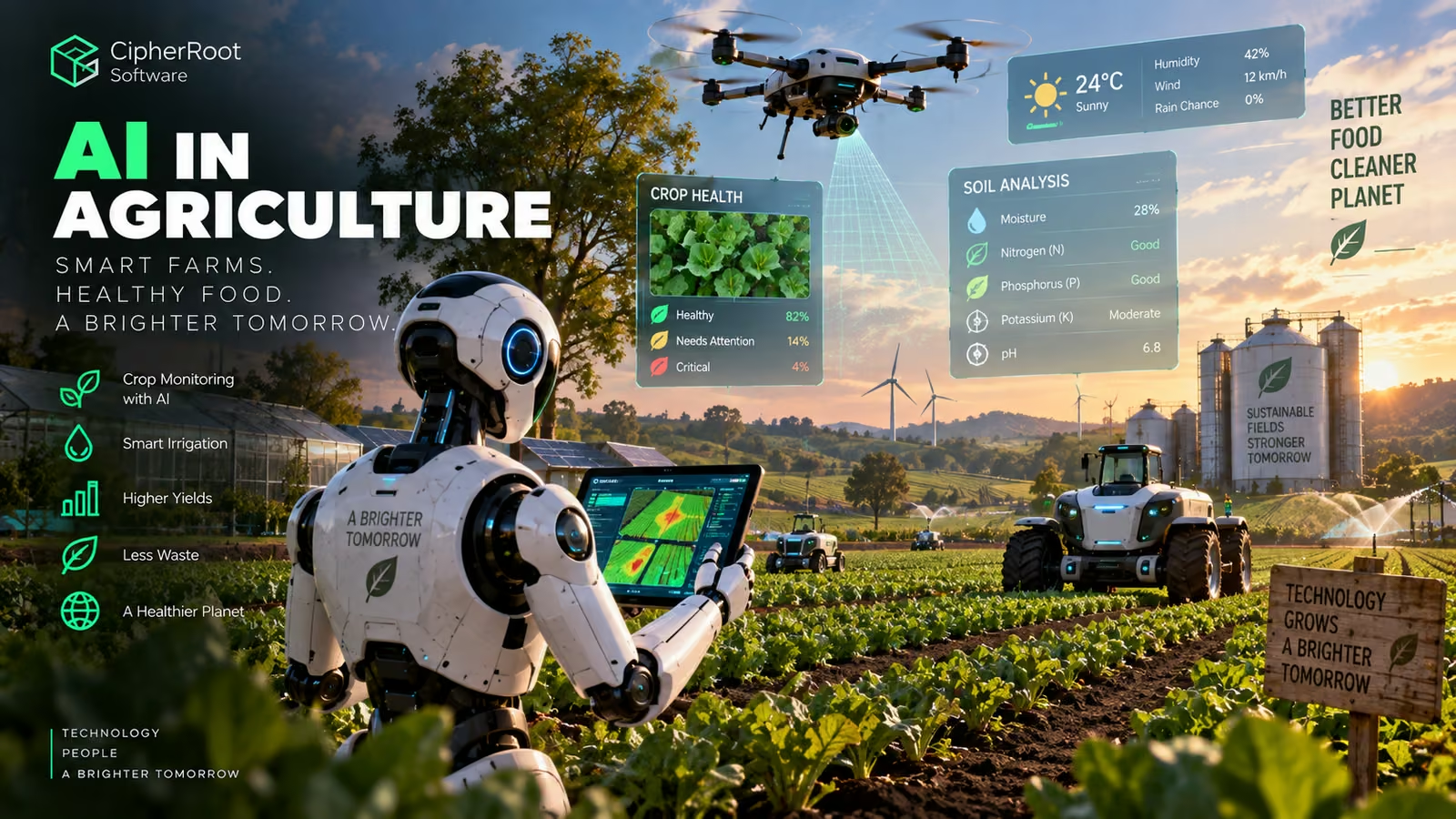
The Future of Farming Is Becoming Intelligent
Agriculture has always depended on observation, experience, timing, and an understanding of nature.
Farmers have traditionally watched the weather, examined soil, monitored crops, managed water, and made decisions based on years of practical knowledge.
Today, another powerful tool is entering the field: artificial intelligence.
AI is transforming agriculture by helping farmers analyze enormous amounts of data, detect problems earlier, automate repetitive tasks, and use resources more precisely.
The result is a new approach to farming often described as smart agriculture or precision agriculture.
The goal is not to replace farmers.
It is to give them better information and better tools.
What Is AI in Agriculture?
AI in agriculture refers to the use of artificial intelligence, machine learning, computer vision, robotics, sensors, and data analysis to improve farming operations.
These technologies can collect and process information about:
- Soil conditions
- Crop health
- Weather patterns
- Water availability
- Pest activity
- Machinery performance
- Field conditions
- Harvest timing
Instead of treating an entire field as one uniform environment, AI can help farmers understand the differences between individual areas.
A field can contain thousands of small variations.
Artificial intelligence can help turn those variations into useful decisions.
AI-Powered Crop Monitoring
One of the most practical uses of AI in agriculture is crop monitoring.
Traditional crop inspection requires farmers and agricultural workers to physically examine plants across large areas.
This can be difficult when farms cover hundreds or thousands of hectares.
AI-powered computer vision can analyze images captured by drones, satellites, cameras, or mobile devices.
These systems can help identify signs of:
- Plant disease
- Nutrient deficiencies
- Water stress
- Pest damage
- Uneven growth
- Environmental stress
Early detection is valuable because agricultural problems can spread quickly.
Finding a problem when it affects a small section of a field can make intervention more targeted.
Drones Are Giving Farmers a New View
Agricultural drones are becoming an important data-collection tool.
A drone can fly over fields and capture detailed images that reveal patterns that may not be obvious from ground level.
AI can then analyze these images.
For example, a system could compare plant color, growth patterns, and field conditions across different areas.
Instead of manually inspecting every section, farmers can receive a visual map highlighting areas that may require attention.
This transforms the field into a continuously monitored digital environment.
Smart Irrigation and Water Management
Water is one of the most important resources in agriculture.
Too little water can damage crops.
Too much can waste resources, increase costs, and potentially affect soil conditions.
AI can combine information from soil sensors, weather forecasts, crop characteristics, and historical field data to support irrigation decisions.
A smart irrigation system could determine that one section of a field needs additional water while another section does not.
This approach makes irrigation more precise.
Rather than watering everything equally, farmers can potentially apply water where and when it is most needed.
Predicting Weather and Agricultural Risks
Weather can have a major impact on agricultural production.
A sudden frost, heatwave, drought, or heavy rainfall event can affect crops in a very short period of time.
AI models can analyze large weather datasets and identify patterns that may help improve agricultural planning.
Farmers can use this information when making decisions about planting, irrigation, harvesting, and crop protection.
AI cannot control the weather.
It can, however, help farmers prepare for changing conditions.
Detecting Pests and Diseases
Pests and plant diseases can cause significant agricultural losses.
Traditional detection often depends on visual inspection and regular field visits.
AI-assisted systems can continuously analyze images from cameras or drones and look for visual patterns associated with specific problems.
In some systems, computer vision can distinguish between healthy and unhealthy plants.
This can support earlier intervention and potentially reduce unnecessary chemical treatments.
The broader idea is simple:
Detect problems earlier. Respond more precisely. Waste less.
Autonomous Agricultural Robots
Agricultural robotics is another major area of development.
Robots can be designed for tasks such as:
- Planting
- Weeding
- Harvesting
- Spraying
- Crop inspection
- Transporting materials
Autonomous robots can use cameras, GPS, sensors, and AI to navigate fields and identify individual plants.
A robotic system could travel between crop rows while detecting unwanted vegetation and targeting specific areas instead of treating an entire field.
This can make agricultural operations more selective and automated.
AI and Precision Agriculture
Precision agriculture is based on a simple principle:
Different parts of a field may need different treatment.
Instead of applying the same amount of water, fertilizer, or crop protection products everywhere, farmers can use data to identify specific requirements.
AI helps make this approach more practical by combining multiple information sources.
A precision farming platform might analyze:
- Satellite imagery
- Soil sensors
- Weather data
- Drone imagery
- Historical yields
- Machinery data
- Crop development
The system can then provide recommendations or automated actions based on the collected information.
Predictive Harvesting
Knowing when to harvest can be difficult.
Harvesting too early can reduce quality or yield.
Harvesting too late can lead to losses.
AI can analyze crop images, environmental conditions, historical data, and growth patterns to estimate when crops may be approaching the optimal harvest period.
Autonomous machinery could eventually use this information to schedule harvesting operations with minimal manual coordination.
This could be especially valuable for large-scale agriculture, where timing and logistics are critical.
Smarter Agricultural Machines
Modern tractors and agricultural machines are becoming increasingly connected.
GPS guidance, cameras, sensors, and onboard computers allow machines to operate with greater precision.
AI can add another layer of intelligence.
A smart tractor could analyze terrain, crop rows, soil conditions, and machine performance while working.
Future systems may increasingly adjust their behavior in real time.
For example, a machine could automatically change speed, route, or operating settings depending on the conditions it encounters.
The tractor becomes more than a machine.
It becomes a data-driven agricultural platform.
Reducing Waste
Agricultural waste can occur at many stages of the farming process.
Water can be overused.
Fertilizer can be applied unnecessarily.
Fuel can be wasted by inefficient machinery routes.
Crops can be lost because problems are discovered too late.
AI can help identify inefficiencies and optimize processes.
A smart farming system can continuously compare actual conditions with expected conditions and highlight areas where resources are being used inefficiently.
Even small improvements can matter when they are applied across large farming operations.
AI and Sustainable Agriculture
The connection between artificial intelligence and sustainability is becoming increasingly important.
Agriculture needs to produce food while managing limited resources.
AI can support this goal by improving the precision of agricultural operations.
Better irrigation can reduce unnecessary water consumption.
More targeted crop protection can reduce unnecessary chemical use.
Optimized machinery routes can reduce fuel consumption.
Improved crop monitoring can help farmers respond to problems earlier.
Sustainability does not come from AI alone.
But AI can provide the information needed to make agricultural systems more efficient.
The Role of Farmers Is Still Central
Technology may change agriculture, but farmers remain at the center of the process.
A computer model can analyze thousands of data points, but farming still involves real-world decisions influenced by local knowledge, experience, economics, weather, and biological conditions.
The most useful AI systems will therefore work alongside farmers.
Instead of replacing human knowledge, technology can combine it with data-driven analysis.
The future may look less like:
Human versus machine
and more like:
Human experience + machine intelligence.
Challenges of AI in Agriculture
Despite its potential, implementing AI in agriculture is not always simple.
Farm environments can be unpredictable.
Internet connectivity may be limited in rural areas.
Sensors can fail.
AI models need high-quality data.
Advanced equipment can also be expensive.
Farmers and agricultural organizations need technologies that are reliable, understandable, and practical rather than simply impressive.
Data ownership and privacy can also become important as farms generate increasingly detailed information about their operations.
For AI to deliver real value, technology must work in the real world—not only in demonstrations.
The Future of Fully Autonomous Farms
The long-term vision is fascinating.
Imagine a farm where sensors continuously monitor soil and environmental conditions.
Drones scan crops automatically.
AI analyzes plant health.
Autonomous tractors prepare and maintain fields.
Robots identify weeds and inspect plants.
Smart irrigation systems deliver water according to real-time requirements.
Harvesting machines coordinate their operations with logistics systems.
The entire farm becomes a connected ecosystem.
A farmer could monitor the operation from a dashboard rather than manually checking every field.
Human oversight would remain important, but many repetitive tasks could become autonomous.
Agriculture Becomes a Data-Driven Industry
The future of farming may depend as much on information as it does on physical machinery.
Every sensor reading, satellite image, weather measurement, machine status, and crop observation can become part of a larger agricultural dataset.
AI can connect these pieces.
Over time, models can become better at identifying patterns and supporting decisions.
This creates an agricultural feedback loop:
Observe → Analyze → Decide → Act → Learn
That cycle could become one of the defining characteristics of next-generation farming.
Conclusion
Artificial intelligence is bringing agriculture into a new technological era.
From crop monitoring and precision irrigation to autonomous tractors, agricultural robots, predictive analytics, and smart resource management, AI can help farmers make more informed decisions and operate more efficiently.
The future of agriculture will not be defined by technology replacing farmers.
It will be defined by technology helping farmers see more, understand more, and waste less.
As AI, robotics, sensors, and connected farming systems continue to evolve, the farm of the future may become one of the most intelligent environments on Earth.
The fields will still grow crops.
The soil will still matter.
The weather will still be unpredictable.
But the tools used to understand and manage all of it will become much smarter.
Smarter farms. Better decisions. More sustainable food production.