
AI & Machine Learning
AI-Generated Movies: How Artificial Intelligence Is Transforming Filmmaking
CipherRoot Software8 min read
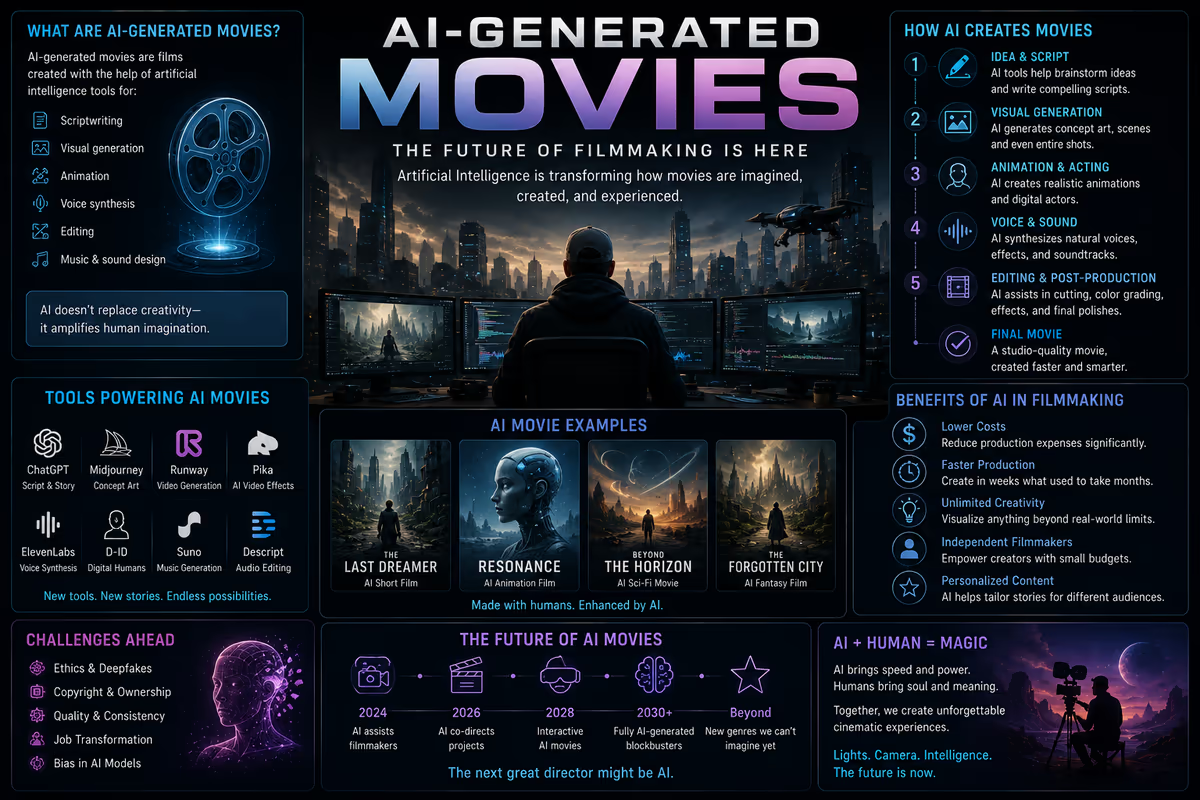
For more than a century, filmmaking has depended on cameras, actors, sets, lighting, visual effects, editors, composers, and large production teams.
Artificial intelligence is beginning to change that workflow.
Today, AI can assist with story development, concept art, image generation, video generation, voice synthesis, music, animation, visual effects, editing, and post-production.
This does not mean that traditional filmmaking is disappearing.
Instead, a new production model is emerging—one where a small creative team can use AI to achieve visual ideas that previously required much larger budgets and production crews.
What Are AI-Generated Movies?
AI-generated movies are films or video productions created partly or extensively with artificial intelligence.
AI can assist with individual stages of production or, in more experimental projects, generate a large portion of the final content.
A modern AI-assisted filmmaking workflow can include:
- Story development
- Scriptwriting
- Character design
- Concept art
- Environment generation
- Video generation
- Digital actors
- Voice synthesis
- Music generation
- Visual effects
- Editing
The important distinction is that AI-generated filmmaking does not necessarily mean a movie created entirely by a machine.
In many cases, the human filmmaker remains the director and creative decision-maker.
How AI Can Create a Movie
A simplified AI filmmaking pipeline might look like this:
Idea → Script → Visual Design → Video Generation → Voice & Music → Editing → Final Film
Each stage can use different AI technologies.
The filmmaker's job becomes increasingly focused on directing the overall creative vision and connecting the individual pieces into a coherent story.
AI and Screenwriting
The first stage of filmmaking is often the idea.
AI can help filmmakers brainstorm:
- Story concepts
- Characters
- Dialogue
- Plot structures
- Scene ideas
- World-building
Alternative endings
A filmmaker could start with a simple concept such as:
"A scientist discovers that an abandoned satellite is still communicating with something beyond the Solar System."
AI could help expand that idea into characters, conflicts, locations, and possible story structures.
The human filmmaker still decides whether the story is actually worth telling.
AI-Generated Concept Art
Before filming begins, productions often create concept art.
AI image-generation systems can dramatically accelerate this process.
A filmmaker can explore different versions of:
- Characters
- Spaceships
- Cities
- Costumes
- Landscapes
- Monsters
- Architecture
- Interior environments
Instead of spending days creating a single concept, a creative team can explore dozens of possibilities rapidly.
This makes visual experimentation much cheaper.
AI Video Generation
One of the biggest developments is AI-generated video.
Modern systems can generate short video sequences from text or visual references.
A filmmaker might describe:
"A futuristic city during a massive electrical storm, viewed from a moving vehicle."
The AI can generate a visual interpretation of that scene.
This technology is still developing, and maintaining consistent characters, environments, physics, and cinematography across long sequences remains challenging.
But the direction is significant.
Digital Actors
AI can also create or animate digital characters.
These characters can potentially:
- Speak
- Move
- Express emotions
- Perform scripted actions
- Appear in different environments
Digital humans are becoming increasingly sophisticated.
This opens possibilities for virtual characters that can appear in films without requiring a traditional physical production setup.
However, using the likeness or voice of real performers requires appropriate consent and rights.
Voice Generation
Voice synthesis has also become increasingly realistic.
AI can generate dialogue for fictional characters and temporary production tracks.
This can be useful during:
- Previsualization
- Animation
- Dubbing
- Localization
- Prototyping
Professional productions must still consider performer rights, licensing, consent, and disclosure when synthetic voices are used.
The technology is powerful, but responsible use matters.
AI-Generated Music
Music is another part of filmmaking that AI can assist with.
AI music systems can help generate ideas for:
- Background scores
- Ambient sound
- Cinematic themes
- Emotional transitions
- Short musical motifs
A filmmaker can experiment with different musical directions before choosing the final sound of a scene.
Human composers can also use AI as an experimentation tool rather than treating it as a replacement for musical creativity.
AI Visual Effects
Traditional visual effects can require specialized teams and expensive equipment.
AI can assist with certain visual-effects workflows, including image manipulation, background generation, object removal, enhancement, and other post-production tasks.
This could make sophisticated visual effects more accessible to independent filmmakers.
A small team may be able to experiment with scenes that previously required a large VFX budget.
AI and Editing
Editing is another area where AI can become an assistant.
AI systems can help organize footage, identify scenes, generate transcripts, create rough cuts, and assist with certain post-production tasks.
The editor still determines the rhythm of the film.
Because editing is not simply about assembling technically correct shots, human judgment remains extremely important.
The difference between a sequence that merely works and one that feels cinematic is often found in timing, emotion, and storytelling.
Independent Filmmakers
Perhaps the biggest impact of AI-generated filmmaking will be felt by independent creators.
Large film productions can spend enormous amounts of money on:
- Sets
- Equipment
- Locations
- Actors
- Crew
- Visual effects
- Post-production
AI can reduce the cost of experimenting with certain aspects of these processes.
A small team could potentially create ambitious science-fiction, fantasy, or historical environments without physically constructing everything.
This could allow more filmmakers to tell stories that previously existed only as ideas.
The New Role of the Director
AI could change what it means to be a director.
Instead of personally controlling every production element, a director may increasingly work as a creative orchestrator.
The director could define:
- Visual language
- Camera style
- Character behavior
- Story structure
- Color and atmosphere
- Pacing
- Emotional tone
AI systems then help transform those decisions into production assets.
The director becomes less of a person controlling every physical component and more of a person controlling the entire creative system.
Consistency Is Still a Major Problem
AI-generated video has impressive capabilities, but it has limitations.
Maintaining the same character across many shots can be difficult.
The appearance of clothing, environments, objects, and even physical details may change unexpectedly.
A successful AI film therefore requires more than generating impressive individual clips.
The real challenge is creating consistent storytelling across an entire production.
Copyright and Ownership
AI-generated filmmaking also creates complicated legal questions.
Who owns an AI-generated image?
What happens when an AI system produces material that resembles existing copyrighted work?
Can a person's likeness or voice be digitally reproduced without permission?
Different jurisdictions and legal systems are continuing to address these questions.
Filmmakers should therefore keep clear records of assets, licenses, permissions, and the tools used during production.
The Impact on Actors and Artists
AI filmmaking will also affect creative professionals.
Actors, voice performers, artists, editors, composers, and other specialists may see some tasks become automated or transformed.
This does not necessarily mean that human creative professionals will disappear.
Instead, their roles may change.
The value of human performance, artistic direction, storytelling, and authenticity could become even more important as synthetic content becomes easier to produce.
AI Could Make Filmmaking More Accessible
Historically, filmmaking has required significant resources.
AI could reduce some of those barriers.
A creator with a powerful computer, creative skills, and access to AI tools could potentially produce:
- Short films
- Trailers
- Music videos
- Animated stories
- Experimental cinema
- Science-fiction sequences
- Fantasy worlds
This could create a new generation of independent filmmakers.
The tools are becoming more accessible.
The difficult part will remain the same:
having something worth saying.
What Will AI Movies Look Like in the Future?
Future AI filmmaking could become increasingly interactive.
Imagine watching a movie where:
Characters respond dynamically.
Scenes change based on the viewer.
Different endings are generated.
Dialogue can be personalized.
Virtual actors can appear in different stories.
Entire environments can be generated in real time.
At that point, the boundary between film, game, and interactive experience could become increasingly difficult to define.
AI + Human Creativity
The strongest filmmaking model may not be:
AI vs. filmmakers
but:
AI + filmmakers.
AI can provide:
- Speed
- Scale
- Experimentation
- Automation
Visual possibilities
Humans provide:
- Story
- Emotion
- Taste
- Meaning
- Direction
- Cultural context
The combination can be extremely powerful.
The Future of Cinema
Cinema has always evolved with technology.
Sound transformed silent films.
Color transformed visual storytelling.
Digital cameras transformed production.
Computer-generated imagery transformed visual effects.
AI may become the next major transformation.
But technology alone does not create great cinema.
A beautiful image without a story is still just an image.
A perfectly generated character without emotional depth is still just a character.
The future belongs to filmmakers who understand both technology and storytelling.
Final Thoughts
AI-generated movies are still in an early stage, but the direction is clear.
Artificial intelligence is becoming a new filmmaking tool capable of assisting with nearly every part of production.
The technology could lower production costs, accelerate experimentation, and allow independent creators to build worlds that were previously too expensive to produce.
At the same time, questions about copyright, consent, employment, authenticity, and artistic ownership will become increasingly important.
The camera may no longer be the only way to create a cinematic image.
The studio may no longer need to be a physical building.
And the production team may become smaller while the creative possibilities become larger.
The future of filmmaking may not be about replacing the filmmaker.
It may be about giving the filmmaker an entirely new kind of creative machine.