
AI & Machine Learning
AI for Scientific Discovery: How Artificial Intelligence Is Changing the Way We Discover the Future
CipherRoot Software15 min read
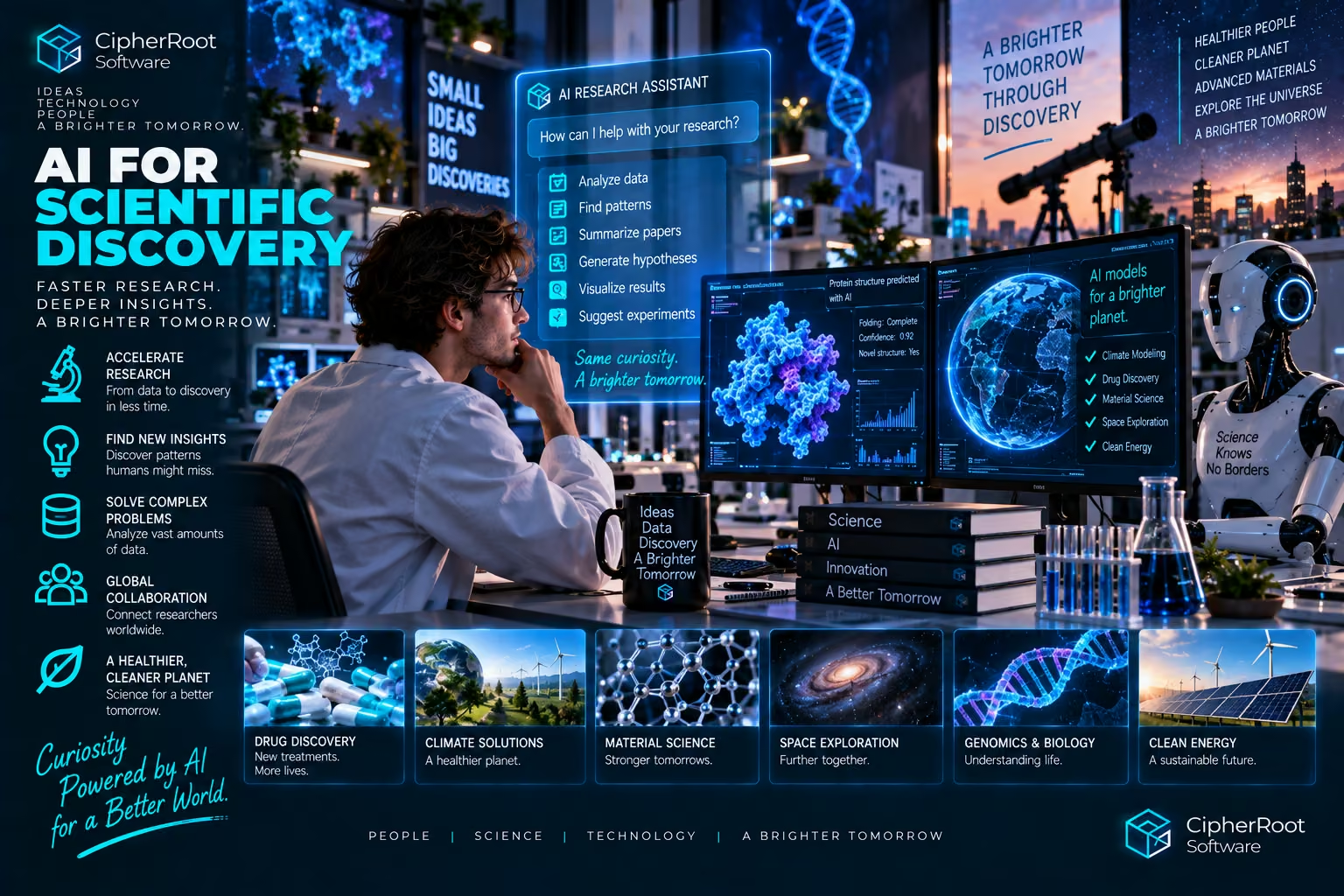
Science Is Entering a New Computational Era
Scientific discovery has always depended on curiosity.
Scientists observe the world, formulate hypotheses, design experiments, collect evidence, and refine their understanding.
But modern science has reached a remarkable point.
The amount of available scientific data is growing rapidly.
Telescopes generate enormous datasets.
Biological experiments produce complex measurements.
Particle physics experiments create huge volumes of information.
Climate models simulate increasingly detailed systems.
Researchers may spend significant amounts of time searching literature, organizing data, testing possibilities, and identifying patterns.
Artificial intelligence can help with many of these tasks.
AI does not replace the scientific method.
Instead, it can provide researchers with new computational tools for exploring questions that would otherwise be extremely difficult to investigate at scale.
The result is a new model of discovery:
Human curiosity + computational intelligence + experimental validation.
What Is AI for Scientific Discovery?
AI for scientific discovery refers to the use of artificial intelligence and machine learning to support scientific research.
Applications can include:
- Data analysis
- Pattern recognition
- Scientific simulation
- Hypothesis generation
- Literature analysis
- Molecular discovery
- Materials research
- Climate modeling
- Image analysis
- Laboratory automation
- Experimental planning
Some systems analyze existing datasets.
Others generate predictions that scientists can test experimentally.
The most important point is that AI does not turn a prediction into a scientific fact.
A prediction becomes meaningful when it can be evaluated against evidence.
Why AI Matters for Science
Scientific datasets can be incredibly complex.
A researcher may have thousands or millions of measurements containing relationships that are difficult to identify manually.
Machine-learning systems can search for patterns across these datasets.
This can help answer questions such as:
Which variables appear to be related?
Which measurements are unusual?
Which structures look promising?
Which experiments may provide the most useful information?
AI can therefore act as a powerful exploration tool.
It can search a much larger space of possibilities than a person could examine manually.
AI as a Research Assistant
One practical application is scientific information management.
Researchers may need to read large numbers of scientific papers, compare findings, track terminology, and identify relationships between studies.
AI can help organize this information.
A research assistant system could potentially:
- Summarize publications
- Extract important findings
- Compare studies
- Search scientific terminology
- Organize references
- Identify related research areas
The researcher still needs to evaluate the original sources.
AI can reduce information overload.
It should not replace scientific reading and verification.
Finding Patterns in Complex Data
Many scientific discoveries begin with unexpected patterns.
A strange signal.
An unusual measurement.
A surprising correlation.
A structure that does not behave as expected.
AI can scan large datasets for anomalies and relationships.
This can be particularly useful in areas where the number of possible interactions is enormous.
The system does not need to know what the discovery will be.
It can simply help researchers identify where to look next.
AI and Hypothesis Generation
A scientific hypothesis is a proposed explanation that can be tested.
AI systems can help generate candidate hypotheses by analyzing existing evidence and identifying possible relationships.
For example, a model could examine:
Variables → Patterns → Candidate relationships
Researchers can then evaluate those ideas.
This creates an interesting workflow:
AI suggests. Scientists test. Evidence decides.
That distinction is essential.
An AI-generated hypothesis is a starting point, not a conclusion.
The Search Space Problem
Many scientific problems contain enormous numbers of possible solutions.
Drug discovery is a good example.
Researchers may need to consider huge numbers of chemical structures and their possible interactions with biological targets.
Materials science can face similar challenges.
A material can have many possible combinations, structures, and properties.
AI can help narrow these search spaces by identifying candidates worth investigating experimentally.
This can make research more efficient.
AI and Drug Discovery
Drug discovery is one of the most promising areas for scientific AI.
Researchers need to identify molecules that may have useful biological properties while considering many other factors.
Machine-learning models can assist with tasks such as:
- Molecular property prediction
- Candidate screening
- Protein-related modeling
- Virtual testing
- Biomarker research
AI can help prioritize candidates before they enter more expensive laboratory stages.
But laboratory experiments and clinical evaluation remain essential.
A computer prediction is not the same thing as a successful medicine.
AI and Protein Science
Proteins are fundamental to biology.
Their structures and interactions influence many biological processes.
Understanding protein structure can therefore be extremely important for biomedical research.
AI systems have demonstrated the ability to predict aspects of protein structure and molecular interactions, opening new possibilities for researchers.
These predictions can help scientists formulate experiments and investigate biological mechanisms.
The important workflow remains:
Prediction → Experimental testing → Scientific validation
AI can accelerate the first stage.
Science still depends on evidence.
AI in Genomics
Genomic datasets contain vast amounts of biological information.
Researchers use computational methods to study relationships between genes, biological functions, diseases, and other characteristics.
AI can identify patterns within genomic data that may be difficult to detect using traditional analysis alone.
Potential applications include:
- Gene analysis
- Variant interpretation
- Biomarker discovery
- Disease research
- Biological classification
The complexity of genomic information makes computational tools increasingly important.
AI and Materials Science
The search for new materials can be extremely time-consuming.
Researchers may want materials with particular combinations of:
- Strength
- Conductivity
- Stability
- Weight
- Thermal properties
- Chemical behavior
AI can help predict which candidate materials may have desirable characteristics.
Researchers can then synthesize and test the most promising candidates.
This approach can shorten the time spent searching through an enormous number of possibilities.
AI for Climate Science
Climate systems are incredibly complex.
They involve interactions between oceans, atmosphere, land, ice, ecosystems, and human activity.
AI can support climate research by analyzing large environmental datasets and improving certain forecasting and modeling workflows.
Potential applications include:
- Weather analysis
- Climate modeling
- Extreme-event research
- Environmental monitoring
- Energy forecasting
- Satellite-image analysis
AI does not eliminate uncertainty in climate science.
It provides additional tools for understanding complex systems.
AI and Space Exploration
Space science generates enormous amounts of information.
Telescopes continuously collect observations.
Spacecraft transmit measurements.
Astronomers analyze images, spectra, and other signals.
AI can help researchers search these datasets.
A machine-learning system can scan large collections of astronomical observations and identify objects or patterns for further investigation.
This can help scientists focus their attention on unusual or potentially interesting discoveries.
The universe produces more data than humans can manually inspect.
AI can help search through it.
Autonomous Scientific Instruments
AI becomes even more interesting when it moves from data analysis into experimental systems.
A laboratory can contain robotic equipment capable of performing repetitive procedures.
AI can potentially help decide which experiment should be performed next based on previous results.
This creates an automated research loop:
Experiment → Data → AI analysis → Next experiment → New data
Instead of running experiments according to a fixed schedule, the system can adapt its next actions to what it has already learned.
This concept is often associated with self-driving laboratories.
The Self-Driving Laboratory
Imagine a laboratory where:
Robotic systems prepare samples.
Sensors collect measurements.
AI analyzes the results.
Software identifies promising experimental conditions.
Robots perform the next experiment.
The cycle repeats.
The scientist supervises the research objectives and validates the scientific conclusions.
This can dramatically increase the number of experiments that can be performed within a given period.
The laboratory becomes a continuous learning system.
AI and Experimental Design
Not every experiment is equally informative.
Researchers often need to decide which experiment should be performed next.
AI can help explore this problem.
A system can examine previous results and identify experiments that are likely to provide useful information.
This can reduce wasted experiments.
The goal becomes:
Do fewer unnecessary experiments while learning more from each one.
That can be extremely valuable when experiments are expensive, slow, or difficult to perform.
Scientific Simulation
Simulation allows researchers to study systems without physically building every possible scenario.
Computational models can represent:
- Chemical reactions
- Physical systems
- Materials
- Biological processes
- Weather
- Engineering structures
AI can help accelerate or approximate certain simulations.
For example, instead of repeatedly running an extremely expensive calculation, a machine-learning model can learn an approximation from previously generated results.
This can make some forms of scientific exploration faster.
AI and Physics
Physics has always relied on mathematical models.
AI adds new computational methods for analyzing complex physical systems.
Machine learning can help identify patterns in experimental measurements, approximate difficult calculations, or assist with simulations.
It can also help researchers search for relationships between variables.
The important distinction remains the same:
AI can discover patterns.
Scientists need to determine whether those patterns have physical meaning.
AI and Particle Physics
Particle physics experiments can generate enormous quantities of data.
Researchers need to identify rare events hidden among many ordinary observations.
Machine learning can assist with classification and event selection.
This can help scientists focus computational resources on events that are more likely to contain useful information.
AI becomes a filter between:
Massive datasets
and
Human investigation
AI in Astronomy
Astronomy produces some of the most visually and computationally challenging datasets in science.
Researchers may analyze:
- Galaxies
- Stars
- Planets
- Supernovae
- Gravitational phenomena
- Spectral measurements
AI can help identify patterns and classify objects across enormous image collections.
A human scientist might examine a small number of examples.
An AI system can examine millions.
This scale can make previously impractical searches possible.
The Rise of Multimodal Scientific AI
Scientific information is not limited to one format.
Researchers work with:
Text
Images
Graphs
Measurements
Simulations
Video
Genomic sequences
Future AI systems can combine multiple forms of scientific information.
A researcher could provide a paper, an experimental dataset, and an image and ask the system to identify relationships.
Multimodal AI could become a powerful interface for scientific work because science itself is multimodal.
AI and Scientific Coding
Programming is already an important part of modern research.
Scientists use code to:
- Analyze datasets
- Run simulations
- Create visualizations
- Process experiments
- Automate workflows
AI coding assistants can help researchers write and explain software more quickly.
This can be particularly useful for researchers who are experts in their scientific field but have limited software-development experience.
However, scientific code still needs testing and validation.
A faster script is not useful if it produces incorrect results.
Reproducibility Matters
Science depends on reproducibility.
A result should be explainable, testable, and ideally reproducible by other researchers.
AI introduces an additional challenge.
Some models can be extremely complex.
Researchers may need to document:
- Training data
- Model versions
- Parameters
- Evaluation methods
- Software versions
- Experimental conditions
This documentation helps other scientists understand and reproduce the work.
The more AI enters scientific research, the more important scientific transparency becomes.
AI Can Also Make Mistakes
Artificial intelligence can identify useful patterns.
It can also identify patterns that are meaningless.
A model may detect a correlation that disappears when tested on new data.
It may learn biases from the dataset.
It may overfit.
It may generate plausible but incorrect explanations.
Science provides a critical defense against these problems:
Test the claim.
An AI system should not be treated as a scientific authority simply because it produces a sophisticated answer.
Human Scientists Remain Essential
Scientific discovery is not just pattern recognition.
Researchers decide:
What question is worth asking?
What counts as evidence?
Which hypothesis should be tested?
How should an experiment be designed?
What are the limitations?
Does the result make scientific sense?
AI can support these processes.
Humans remain responsible for interpreting evidence and defining scientific goals.
The most powerful future is therefore collaborative.
AI and Scientific Creativity
Creativity is essential to research.
Scientists need to imagine mechanisms that have not yet been observed.
They need to connect ideas from different disciplines.
They need to ask unusual questions.
AI can help expand that creative search space.
A system can generate possible explanations or point researchers toward unexpected relationships.
The human scientist can then decide which ideas deserve attention.
This resembles a brainstorming partnership.
AI creates possibilities.
Science determines which possibilities survive.
Cross-Disciplinary Discovery
Some of the most interesting discoveries occur between fields.
Biology can learn from physics.
Materials science can borrow methods from chemistry and engineering.
Computer science can contribute to medicine.
AI can help researchers search across these boundaries.
A system that understands terminology from multiple disciplines could potentially identify connections that would be easy for specialists in separate fields to overlook.
This can encourage more cross-disciplinary research.
AI and Rare Discoveries
Rare events are difficult to find.
They may be hidden inside enormous datasets.
AI can help identify unusual patterns that deserve human investigation.
This can be useful in astronomy, particle physics, genomics, medical imaging, and many other domains.
The machine does not need to know that something is a major discovery.
It simply needs to say:
“This pattern is unusual. You should look here.”
Sometimes that is enough to change the direction of research.
Scientific Knowledge Becomes More Searchable
One of the biggest long-term effects of AI could be making scientific knowledge easier to navigate.
Scientific literature has grown enormously.
Researchers cannot realistically read everything in their field.
AI can help create searchable maps of knowledge.
A researcher may eventually be able to ask:
“What are the strongest explanations for this phenomenon?”
or:
“Which experiments have tested similar hypotheses?”
This can reduce the time required to move from a question to relevant scientific context.
AI and Open Science
AI can also support open scientific workflows.
Researchers can use intelligent systems to organize datasets, document analysis pipelines, and make complex information more accessible.
However, openness must be balanced with privacy, security, intellectual-property considerations, and responsible data sharing.
Not every scientific dataset can simply be published publicly.
Good AI infrastructure should support appropriate access rather than unrestricted access by default.
The Ethics of AI in Science
AI can accelerate scientific research.
That power creates responsibilities.
Researchers need to consider:
- Data provenance
- Privacy
- Bias
- Research integrity
- Reproducibility
- Model limitations
- Misuse risks
An AI system that produces results quickly is not necessarily a trustworthy scientific instrument.
Trust must come from evidence, validation, documentation, and transparent methods.
The Future of AI-Driven Laboratories
The laboratory of the future may look very different.
Researchers could interact with intelligent systems through natural language.
AI could analyze experimental data immediately.
Robotic equipment could perform routine procedures.
Digital twins could simulate experiments.
Automated platforms could propose the next experimental step.
Scientists could focus more of their time on theory, interpretation, and high-level research strategy.
The laboratory becomes a combination of:
Humans + AI + Robots + Data + Simulation
The Scientific Discovery Loop
A future AI-assisted research process may look like this:
Question
A scientist defines an important problem.
Knowledge
AI searches relevant scientific information.
Hypothesis
The system generates possible explanations.
Simulation
Computational models explore the possibilities.
Experiment
Robotic or human researchers test the most promising candidates.
Analysis
AI examines the results.
Validation
Scientists independently evaluate the evidence.
Discovery
A new result becomes part of scientific knowledge.
This creates a continuous discovery cycle.
AI Could Change the Speed of Science
Scientific progress is often limited by how quickly experiments can be designed and performed.
If AI and robotics can accelerate these loops, some areas of research could move faster.
The effect may not be uniform.
Some problems require years of observation.
Some experiments depend on physical processes that cannot be accelerated easily.
Others are primarily limited by computation or information processing.
AI is most powerful where it can remove those bottlenecks.
The Human Advantage
Even in a highly automated laboratory, humans retain something essential.
They decide what questions matter.
Science is not simply a search for patterns.
It is a search for understanding.
A computer can find a statistical relationship.
A scientist asks why it exists.
A model can predict an outcome.
A researcher asks whether the prediction makes sense.
A robotic system can perform thousands of experiments.
A human decides which discovery is meaningful.
That distinction will remain important.
The Future: AI as a Scientific Partner
The long-term future may not be a scientist replaced by an AI system.
It may be a scientist equipped with an intelligent research partner.
The AI can search.
The AI can calculate.
The AI can simulate.
The AI can identify patterns.
The AI can propose possibilities.
The scientist can question.
The scientist can design.
The scientist can validate.
The scientist can interpret.
Together, they can explore scientific questions at a scale that neither could manage as effectively alone.
Conclusion
Artificial intelligence is becoming an important tool for scientific discovery.
It can help researchers analyze enormous datasets, search scientific literature, generate hypotheses, simulate complex systems, discover potential molecules and materials, monitor the environment, and automate laboratory workflows.
The most important transformation is not that AI makes science automatic.
It is that AI can expand the search space of what scientists can investigate.
A researcher can explore more possibilities.
A laboratory can perform more experiments.
A model can analyze more data.
A scientific team can discover relationships that might otherwise remain hidden.
But the foundation of science does not change.
Predictions must be tested.
Claims must be evaluated.
Results must be reproducible.
Evidence matters.
AI can accelerate discovery.
Human curiosity gives discovery its direction.
The future of science may therefore be a partnership between two very different forms of intelligence.
Human imagination. Machine computation. Experimental evidence.
The greatest discoveries of tomorrow may begin with a question that a human asks—and an AI system helps us investigate.