
AI & Machine Learning
AI for Content Creators: How Artificial Intelligence Is Changing the Creative Process
CipherRoot Software13 min read
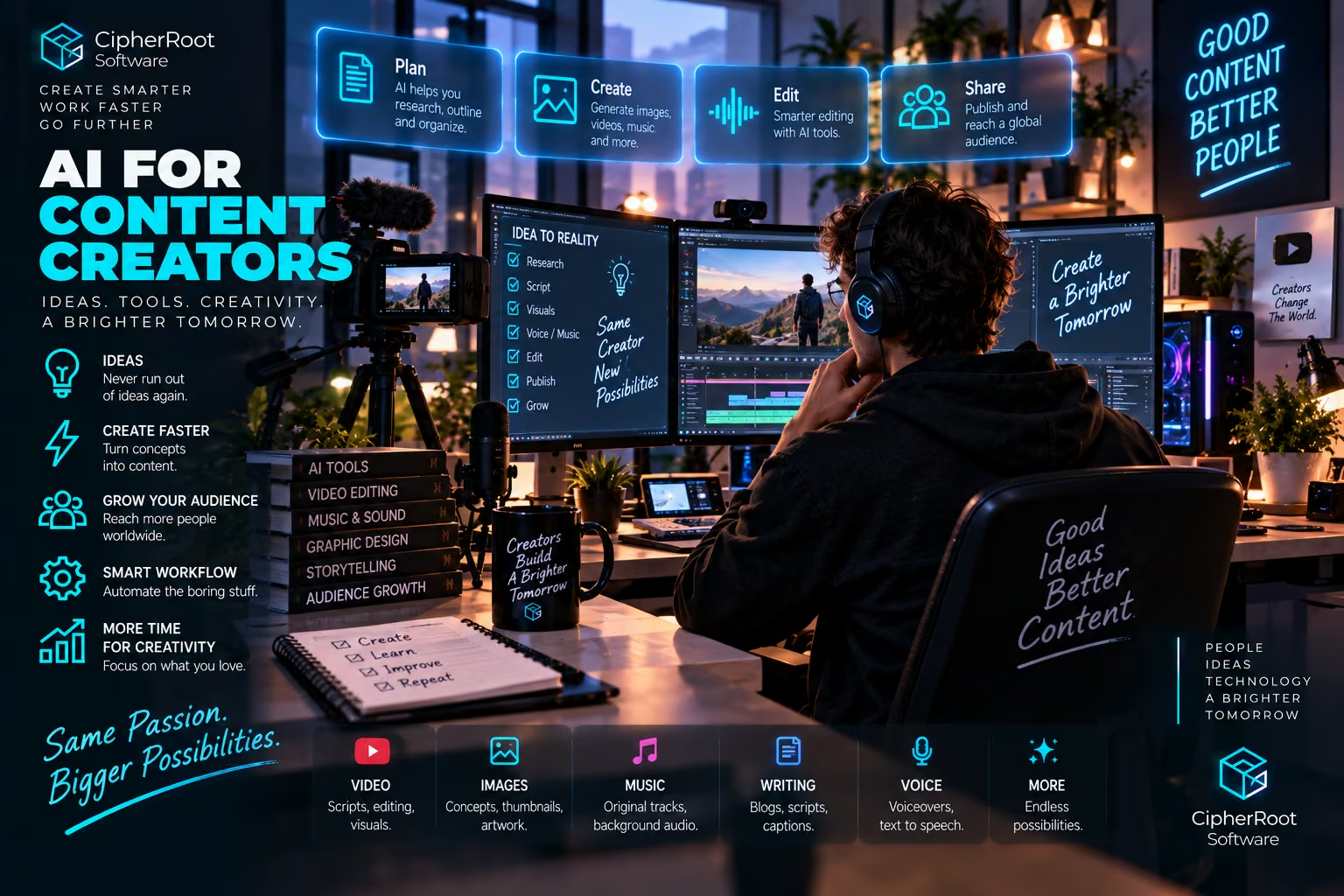
Creativity Is Entering a New Era
Content creation has always been a combination of ideas, skill, technology, and persistence.
Writers create stories.
Filmmakers create videos.
Designers create visuals.
Musicians create sound.
YouTubers, streamers, photographers, and independent creators turn ideas into experiences for audiences around the world.
Now artificial intelligence is becoming another tool in the creative process.
AI can help creators research topics, generate ideas, write drafts, create images, edit videos, produce audio, translate content, and automate repetitive workflows.
But the most interesting part is not that AI can generate content.
It is that AI can potentially give creators more time to create.
What Is AI for Content Creation?
AI for content creation refers to the use of artificial intelligence to support different stages of the creative workflow.
These stages can include:
Research Idea generation Writing Image creation Video production Audio production Editing Translation Publishing Audience analysis
AI can be used for a single task or integrated into a complete production pipeline.
A creator might use one AI system for brainstorming, another for image generation, and another for video or audio editing.
The result is a workflow where software handles more of the repetitive preparation.
From Idea to Finished Content
Traditional content production can involve many separate steps.
A video creator may need to research a topic, write a script, record footage, edit the video, create a thumbnail, write a description, add subtitles, and publish it.
AI can assist at multiple points.
A workflow might look like:
Idea → Research → Script → Visuals → Editing → Voice → Publishing → Analysis
AI can provide assistance throughout this chain.
This does not mean every stage should be automated.
Creative decisions still matter.
But reducing repetitive work can make the entire process faster.
AI and Content Ideas
One of the hardest moments for creators is sometimes the beginning.
What should I make next?
What topic would interest my audience?
What angle has not been explored?
AI can help generate possibilities.
A creator can ask an AI system to brainstorm:
Video topics Article ideas Short-form content Story concepts Podcast subjects Social media posts Series ideas
The AI does not need to provide the final idea.
It can simply create a larger field of possibilities.
The creator then decides which ideas are worth developing.
This can turn the blank page into a starting point.
AI for Research
Research can consume a large amount of time.
Creators often need to read articles, examine references, compare information, organize notes, and find useful background material.
AI can assist with these tasks.
It can help:
Summarize long documents Organize notes Extract key topics Compare information Create research outlines Identify questions worth exploring
However, AI-generated research should still be checked carefully.
A creator remains responsible for the accuracy of published information.
AI can accelerate research.
It should not replace verification.
AI Writing Assistants
Writing is another area where AI can help.
A creator can use AI to generate a first draft, explore different structures, or rewrite a passage in a different tone.
Potential uses include:
Blog posts
Video scripts
Captions
Newsletters
Product descriptions
Podcast outlines
Social media copy
The biggest advantage may not be having AI write everything.
It may be avoiding the slowest parts of writing.
A creator can begin with an AI-generated structure and then add personal experience, opinions, storytelling, and original insights.
The final piece becomes a collaboration between machine assistance and human authorship.
AI for Video Creators
Video production contains many repetitive tasks.
AI can assist with:
Transcription Subtitle generation Scene organization Audio cleanup Rough cuts Background removal Caption generation Content repurposing
Imagine finishing a long video and automatically receiving a transcript, subtitle file, short clips, and a draft description.
That does not replace the editor.
It removes some of the mechanical work around editing.
The creator can then spend more time on pacing, storytelling, visual style, and emotional impact.
Generative Video
Generative AI is also changing the creative possibilities of video.
Creators can increasingly experiment with generated scenes, visual concepts, animations, and other synthetic media.
This can be especially useful for:
Concept development Previsualization Motion graphics Background scenes Experimental storytelling Short-form content
The technology is still evolving rapidly.
Consistency, realism, controllability, and production reliability remain important challenges.
But the direction is significant.
Some parts of video production can begin before a camera is ever turned on.
AI Image Generation
Image generation has become one of the most accessible creative AI applications.
A creator can describe a visual concept and generate an image in seconds.
This can be useful for:
Blog headers Thumbnails Concept art Storyboards Marketing visuals Social media graphics Backgrounds Character concepts
For creators, the biggest change is speed.
A visual idea that once required hours of design work can now be explored almost instantly.
This makes experimentation much cheaper.
The Importance of Art Direction
Generating an image is easy.
Creating the right image is harder.
AI can produce thousands of possibilities.
The creator still needs to decide:
What style fits the brand?
What composition communicates the idea?
What colors feel appropriate?
Which image tells the story?
Which version should be published?
This makes art direction increasingly important.
The AI creates possibilities.
The creator provides the visual identity.
AI for Music and Audio
Audio production is another area where AI can help creators.
AI tools can assist with:
Voice generation Noise reduction Transcription Sound design Music creation Audio cleanup Voice enhancement Translation and dubbing
A creator producing a video can potentially generate supporting audio without building every element manually.
Podcasters can use AI for transcription.
Video editors can automate repetitive audio-cleaning tasks.
Musicians can experiment with new ideas during the composition process.
AI Voice and Dubbing
Language can be a major barrier for creators trying to reach international audiences.
AI-assisted translation and voice technologies can help transform content into multiple languages.
A creator could potentially produce:
Translated subtitles Multilingual descriptions Dubbed videos Localized social posts
This can make the same piece of content accessible to a wider audience.
However, translation quality, voice identity, cultural context, and consent remain important considerations.
Repurposing One Piece of Content
One of the most powerful creator workflows is content repurposing.
A long-form video can become:
A full YouTube video
→ Short clips
→ Social media posts
→ Blog article
→ Newsletter
→ Podcast segment
→ Quote graphics
AI can help generate many of these variations.
Instead of creating every piece from scratch, the creator starts with one core idea and adapts it across different platforms.
This can dramatically improve the efficiency of a content pipeline.
AI and Social Media
Social media requires consistency.
Creators often need to publish frequently while maintaining a recognizable style.
AI can help prepare:
Captions Post variations Content calendars Hashtag ideas Promotional copy Short-form scripts
Again, the most useful role is often preparation rather than complete automation.
A creator's personality should remain visible.
Otherwise, content can quickly become generic.
Audience Analysis
Content creation is not only about producing material.
It is also about understanding what the audience responds to.
AI can help analyze data such as:
Views Watch time Engagement Click-through behavior Audience comments Content performance
The goal is not to blindly follow metrics.
Creators can use analytics to identify patterns.
Which topics consistently attract attention?
Where do viewers stop watching?
Which formats produce meaningful engagement?
Which content attracts returning audiences?
AI can make these questions easier to investigate.
AI and Personal Branding
Personal branding becomes even more important when content generation becomes easier.
If everyone can generate an image, write a caption, or produce a video quickly, the creator's unique identity becomes a stronger differentiator.
Personal branding can come from:
Voice Visual style Storytelling Experience Humor Expertise Perspective
AI can help a creator produce more.
It cannot automatically create an authentic identity.
That comes from the person behind the content.
AI Can Make Small Creators More Competitive
Large media organizations have historically had an advantage because they could employ writers, editors, designers, researchers, and production teams.
AI can reduce some of that gap.
A single creator can potentially access tools that assist with:
Research Writing Graphic design Video editing Audio production Translation Marketing
This can give small teams more leverage.
The result may be a more decentralized creative economy where individuals can produce professional-looking work without building a large production department.
The Creator as a Creative Director
As AI handles more production mechanics, the creator's role can evolve.
Instead of doing every task manually, the creator can become more like a creative director.
They decide:
What should be created?
Why should it exist?
Who is it for?
What should it feel like?
Which version is strongest?
What should be changed?
This shift from maker of every component to director of the entire system may become one of the most important changes in creative work.
AI and Independent Filmmakers
Independent filmmakers often work with limited budgets.
AI can help reduce production barriers by supporting:
Previsualization Storyboarding Concept art Script development Voice production Visual effects Editing Localization
This does not eliminate the need for traditional filmmaking skills.
Cinematography, acting, editing, storytelling, sound design, and directing remain important.
AI simply adds another layer of tools.
AI and Game Creators
Game development is another creative field being influenced by AI.
Developers can use AI to assist with:
Concept art Character ideas Dialogue World building Code Texture generation Testing Documentation
Small teams can experiment with ideas more quickly.
This is especially interesting for independent developers who previously needed larger teams to produce certain assets.
The result may be more experimentation and more niche games.
AI for Graphic Designers
Graphic design workflows can also become faster.
AI can help creators explore:
Layouts Color combinations Concepts Backgrounds Image variations Typography ideas
But professional design is still about communication.
A beautiful image can fail if the message is unclear.
Human designers remain responsible for hierarchy, composition, brand consistency, and visual storytelling.
AI is a tool.
Design is the discipline.
The Risk of Generic Content
There is a hidden problem with AI-assisted creation.
When everyone uses similar tools, content can begin to look the same.
The same visual styles.
The same phrases.
The same structures.
The same ideas.
This creates a new challenge:
How do you remain original in an environment where production is nearly unlimited?
The answer is not necessarily avoiding AI.
It may be using AI while adding more of what machines do not automatically provide:
Personal experience.
Original perspective.
Unique taste.
Strong storytelling.
Cultural understanding.
Unexpected ideas.
Quality Still Matters
AI makes quantity easy.
That makes quality more important.
Creators can publish more content than ever.
But audiences still have limited attention.
A thousand average posts are not necessarily more valuable than ten exceptional ones.
AI should therefore help creators increase quality rather than simply increase volume.
The question should always be:
Does this make the audience's experience better?
Copyright and Ownership
Generative AI also raises important questions about creative rights and ownership.
Creators need to understand the terms of the tools they use and the rights associated with generated or transformed content.
The legal environment continues to evolve across jurisdictions and technologies.
For professional creators and businesses, reviewing licensing terms and applicable copyright rules is an important part of the workflow.
AI does not remove legal responsibility.
Disclosure and Authenticity
Creators may also need to consider whether audiences should know when AI has been used.
This depends on the type of content and the context.
A creator using AI for background cleanup is different from publishing a fully synthetic performance presented as real.
Transparency can help maintain audience trust.
The more AI becomes integrated into media production, the more valuable authenticity becomes.
AI Workflow Automation
The most powerful creator setups may eventually be built as automated pipelines.
For example:
A topic is selected.
AI researches the subject.
A script is drafted.
Visuals are generated.
Voice is produced.
The video is assembled.
A thumbnail is created.
Descriptions and captions are prepared.
The final content is reviewed by the creator.
The creator approves publication.
Performance data is then analyzed and fed back into the next cycle.
This creates a continuous creative system.
Idea → Production → Distribution → Analysis → Improvement
The Future of Content Creation
Content creation is likely to become increasingly multimodal.
A creator may work with text, images, video, audio, 3D environments, avatars, and interactive experiences from one workflow.
AI systems will increasingly understand relationships between these formats.
A script could generate a visual plan.
A visual concept could generate a scene.
A scene could generate a short video.
A video could produce captions and social clips automatically.
The borders between different media formats will become less rigid.
The Rise of the One-Person Studio
One of the most interesting possibilities is the one-person studio.
A single creator could potentially operate:
A writing system.
A design assistant.
A video editor.
An audio system.
A publishing workflow.
An analytics assistant.
An AI agent for administration.
This does not mean one person becomes equal to an entire Hollywood studio.
It means the cost of experimentation can drop dramatically.
A creator with a strong idea can potentially build more with fewer resources.
Creativity Becomes the Competitive Advantage
When production becomes easier, creativity becomes more important.
The tools become widely available.
The difference comes from how they are used.
Two creators can have access to the same AI systems and produce completely different results.
One creates generic content.
The other develops a recognizable style.
The difference is not the model.
It is the creative vision.
Building a Healthy AI Workflow
A strong AI workflow should have clear boundaries.
Use AI for tasks that benefit from speed.
Use human judgment for decisions that require taste, context, and responsibility.
Verify factual information.
Review generated content.
Protect sensitive data.
Maintain a consistent creative identity.
Keep experimenting.
The objective is not to remove the creator from the process.
It is to give the creator more control over the creative process.
Conclusion
Artificial intelligence is transforming content creation by making research, writing, design, video production, audio processing, translation, and publishing faster and more accessible.
For independent creators, this can be especially powerful.
A single person can now combine tools that previously required multiple specialized roles.
But AI does not automatically create great content.
Great content still depends on ideas, experience, taste, storytelling, originality, and an understanding of the audience.
The future of content creation will therefore not simply belong to people who generate the most.
It will belong to creators who know what is worth creating.
AI can handle more of the production.
Humans can focus more on vision.
And when those two strengths work together, the creator's studio becomes much bigger than the room they work in.
More ideas. Faster production. Stronger creativity.
The future creator may not be a person working alone.
They may be a person working with an entire invisible team of intelligent tools.