
AI & Machine Learning
AI and the Metaverse: How Artificial Intelligence Could Shape Virtual Worlds
CipherRoot Software13 min read
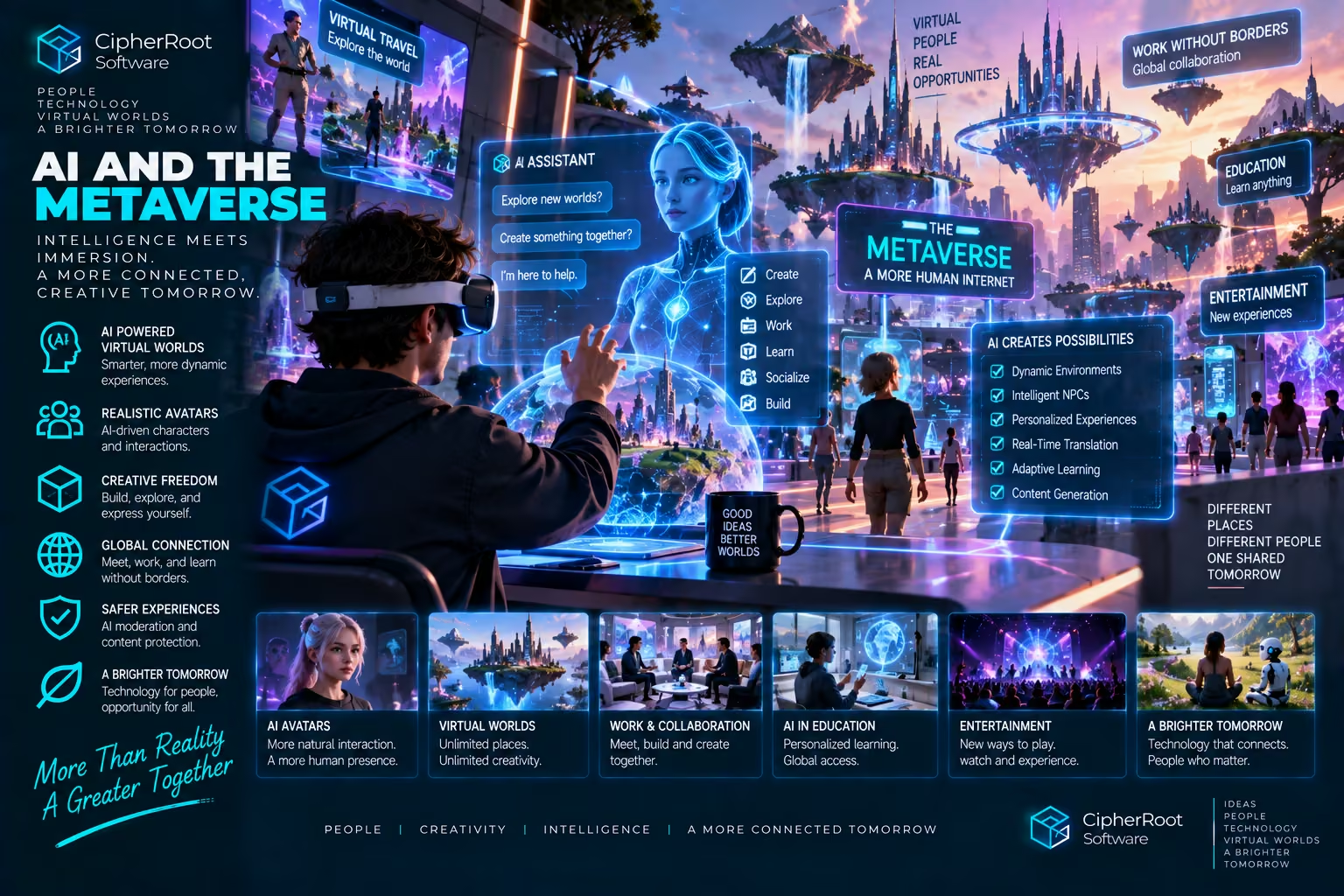
Intelligence Meets Immersion
The internet changed how people communicate.
Social platforms changed how people share experiences.
Virtual reality introduced new ways to enter digital environments.
Now artificial intelligence is bringing another layer to immersive technology.
The combination of AI and the metaverse could create digital spaces that are more interactive, personalized, and responsive than today's traditional applications.
Instead of simply entering a virtual world and following predefined rules, users could interact with environments that understand language, recognize context, generate content, and adapt to individual behavior.
The metaverse of the future may therefore be less about entering a static virtual world.
It may be about entering a world that can change around you.
What Is the Metaverse?
The metaverse is a broad concept rather than one single platform.
It generally refers to persistent or interconnected digital environments where people can interact through avatars, immersive interfaces, virtual objects, and shared experiences.
These environments can include:
Virtual reality spaces Augmented reality experiences Social virtual worlds Digital workplaces Interactive games Virtual marketplaces Educational environments
The exact definition varies between companies, researchers, and communities.
What makes the concept interesting is the combination of identity, interaction, digital environments, and real-time social experiences.
Why AI Matters to the Metaverse
A virtual world can contain beautiful graphics and immersive environments.
But graphics alone do not create an intelligent experience.
AI can add:
Language understanding
Users can communicate naturally with digital systems.
Computer vision
Virtual environments can interpret visual information.
Generative AI
Software can create new text, images, audio, and environments.
Behavioral adaptation
Digital systems can personalize experiences.
Autonomous agents
AI-driven characters can act without constant human control.
This can transform virtual worlds from static environments into more dynamic systems.
Intelligent Avatars
Avatars are one of the most visible parts of virtual worlds.
Traditional avatars follow predefined animations.
AI-powered avatars can potentially become more expressive and responsive.
An intelligent avatar could:
Understand speech Respond conversationally Express emotions through animation Adapt to social situations Remember selected context Translate between languages
This could make virtual interactions feel more natural.
The avatar becomes more than a digital representation.
It becomes an interactive identity.
AI-Generated Virtual Characters
Virtual worlds often require enormous numbers of characters.
Creating every character manually can be expensive.
Generative AI can help create:
Dialogue Personalities Background stories Visual identities Voice characteristics Behavioral patterns
Instead of programming every conversation manually, developers could create systems capable of generating context-sensitive dialogue.
A virtual city could contain thousands of characters that behave differently.
The environment becomes more alive.
Intelligent NPCs
Games have used non-player characters for decades.
Most NPCs follow predefined behavior trees or scripted dialogue.
AI could make these characters significantly more flexible.
Imagine talking to an NPC and asking a completely unexpected question.
Instead of responding with:
“I don't understand.”
the character could interpret the request and respond appropriately.
This does not require every NPC to become fully autonomous.
Even limited AI capabilities can make interactions feel much less predictable.
AI-Generated Worlds
Generative AI could also influence the environments themselves.
A user might describe:
“Create a futuristic coastal city at sunset.”
An AI-powered system could potentially generate portions of the environment.
It could create:
Buildings Streets Landscapes Lighting Weather Objects Background characters
This could dramatically change how virtual worlds are created.
Instead of building every object manually, designers could guide intelligent generation systems.
Infinite Virtual Environments
Traditional digital environments are limited by development resources.
AI-generated content could potentially make worlds much larger.
A game or virtual platform could generate new environments dynamically.
A user enters a new area.
The system generates appropriate surroundings.
Another user enters a different location.
The environment adapts.
This could create virtual worlds that are larger and more varied without every location being manually constructed.
Personalized Virtual Worlds
The same virtual environment does not have to look identical for every user.
AI can potentially personalize experiences according to preferences.
One user might prefer a minimalist environment.
Another might want a highly futuristic space.
A student might receive an educational environment.
A gamer might receive a more challenging experience.
Personalization could turn the metaverse from a shared static environment into a system that adapts to different users.
AI Companions
One of the most interesting possibilities is the AI companion.
An AI companion could exist inside a virtual world and interact with users over long periods.
It might help with:
Navigation Learning Social interaction Storytelling Games Virtual tasks Creative projects
The companion could remember appropriate context and adapt its behavior.
This creates a new category of digital relationship.
However, developers will need to consider privacy, emotional attachment, and transparency carefully.
Users should know they are interacting with an artificial system.
AI and Virtual Socialization
Social interaction is central to the metaverse concept.
AI can assist by reducing language barriers and making virtual environments easier to navigate.
For example, an AI system could:
Translate conversations.
Summarize discussions.
Help introduce people.
Recommend communities.
Moderate harmful content.
Provide accessibility features.
This could make large virtual communities easier to manage.
Real-Time Translation
Imagine entering a virtual conference where ten people speak different languages.
AI could translate conversations in real time.
Each participant could hear or read the interaction in their preferred language.
This could make virtual communities more international.
The metaverse becomes less limited by geography and language.
Instead of everyone meeting in the same physical location, they meet in a shared digital environment where AI helps bridge communication differences.
AI and Virtual Workspaces
Remote work has already shown that many professional activities can happen digitally.
The metaverse could add spatial interaction.
Teams could meet in virtual offices.
Designers could examine 3D models together.
Engineers could inspect virtual prototypes.
Architects could walk through digital buildings.
Researchers could visualize complex data.
AI can support these environments by organizing information, summarizing meetings, assisting with documents, and helping teams interact with complex virtual objects.
The office becomes less about desks and more about shared digital space.
AI-Powered Education in the Metaverse
Education could become one of the most interesting applications.
Imagine learning history inside a virtual reconstruction of an ancient city.
Or studying astronomy inside a simulated solar system.
Or practicing engineering inside a virtual laboratory.
AI can act as a tutor inside these environments.
It could explain concepts, answer questions, create exercises, and adapt difficulty.
The combination becomes:
Immersion + Intelligence + Interaction
This can make digital learning more experiential.
Virtual Training
Professional training can also benefit from immersive AI environments.
A trainee could practice:
Industrial maintenance Emergency response Equipment operation Healthcare procedures Customer-service situations
The AI system could generate realistic scenarios and adapt them based on the trainee's performance.
This allows repeated practice without exposing the learner to real-world risks.
AI and Healthcare Experiences
Virtual environments can also support certain healthcare and rehabilitation applications.
AI can personalize simulations.
Virtual environments can support training.
Patients can potentially interact with digital therapeutic or educational experiences under appropriate professional guidance.
Healthcare applications require particularly strong privacy and safety standards.
The technology should support healthcare professionals rather than make unsupported medical claims.
AI for Virtual Commerce
Digital worlds can contain virtual marketplaces.
Users may purchase:
Digital clothing Virtual objects Game items Experiences Services Digital collectibles
AI can help personalize these environments.
It can assist with product discovery, recommendations, customer support, and virtual sales experiences.
A future digital store might not look like a website.
It might be a three-dimensional environment where an AI assistant helps users explore products.
Digital Ownership and Blockchain
Blockchain technology can potentially play a role in some virtual economies.
Digital tokens can represent certain virtual assets or ownership records.
This could allow experiments with:
Digital collectibles Virtual property Tickets Memberships In-game assets
AI and blockchain could therefore become complementary technologies.
AI manages interaction and intelligence.
Blockchain can provide selected ownership or transaction infrastructure.
Neither technology is necessary for every metaverse application.
The architecture should depend on the actual requirements.
The Metaverse and AI-Generated Content
One of the biggest changes could be the speed at which virtual content is created.
A traditional development team may spend weeks creating a virtual environment.
Generative systems can help reduce the time required for early concepts.
A creator can describe:
A cyberpunk city
A medieval village
An alien planet
A futuristic laboratory
The AI can produce a starting point.
The creator then refines it.
This creates a much faster creative loop.
Users Become Creators
The metaverse could increasingly allow ordinary users to create their own environments.
A person does not need to know professional 3D modeling.
They could describe what they want.
AI generates the initial environment.
The user edits it.
Friends join.
The world continues to evolve.
This transforms the user from a consumer into a creator.
AI-Driven Storytelling
Virtual worlds can also become dynamic storytelling environments.
Instead of following one fixed storyline, an AI system could adapt the experience to user choices.
Characters remember interactions.
Events change based on decisions.
Locations evolve.
Stories branch.
This creates a different kind of narrative:
A story that responds to the participant.
The user does not simply watch the story.
The user helps create its direction.
AI and Virtual Reality
Virtual reality can provide immersive interfaces for AI systems.
A user can speak naturally.
They can look at objects.
They can interact with digital environments through movement.
AI can interpret these signals.
This creates a more embodied form of computing.
Instead of interacting with an AI through a flat chat window, the user enters a space where the AI exists as part of the environment.
AI and Augmented Reality
The same concepts can move into the physical world through augmented reality.
Digital objects can appear over real environments.
AI can recognize physical objects and provide contextual information.
A person could look at a machine and receive instructions.
A tourist could see historical information about a building.
A student could see a virtual model over a physical object.
The boundary between metaverse concepts and everyday reality becomes less clear.
Persistent Digital Identity
The metaverse raises an important question:
Who are you online?
A person may have multiple accounts across multiple platforms.
Future systems may explore portable digital identities and avatars.
AI could help users maintain consistency across different virtual environments.
However, persistent identity also creates privacy concerns.
A digital identity system should give users meaningful control over what information is shared.
Privacy in AI-Powered Virtual Worlds
Virtual environments can collect large amounts of information.
They may observe:
Voice Movement Eye direction Interactions Location Preferences Behavior patterns
AI can make sense of this information.
That can create highly personalized experiences.
It can also create highly detailed profiles.
Privacy therefore needs to be considered from the beginning.
Users should have clear choices about data collection and use.
AI Moderation
Large virtual communities need moderation.
AI can help identify potentially harmful or abusive behavior.
It can monitor certain types of content.
It can help prioritize reports.
It can assist human moderators.
But automated moderation is not perfect.
Context can be difficult.
Sarcasm can be misunderstood.
Cultural differences can create ambiguity.
Human review remains important for complex cases.
Security in the Metaverse
Virtual platforms are still software systems.
That means they can be attacked.
Users may face:
Account theft Identity abuse Malicious software Fraud Data breaches
AI can help detect suspicious behavior, but AI itself must also be secured.
Future metaverse infrastructure will need strong authentication, encryption, access controls, and monitoring.
AI Agents in Virtual Worlds
The next generation of virtual environments may contain autonomous AI agents.
These agents could act as:
Guides Traders Teachers Characters Developers Assistants Moderators
Some could operate continuously.
A virtual economy could contain agents interacting with one another.
An AI guide could assist visitors.
A virtual shop assistant could help users select products.
An autonomous character could participate in a game without a human player controlling it.
The possibilities are enormous.
AI and Virtual Economies
If virtual worlds become more persistent, they may contain increasingly sophisticated digital economies.
Users could create and exchange digital goods.
Businesses could provide virtual services.
Creators could sell experiences.
AI agents could potentially manage approved transactions.
This creates a new economic environment.
But it also creates new questions around ownership, fraud, taxation, regulation, and consumer protection.
The Energy Challenge
AI and immersive computing require significant computing resources.
Virtual worlds can involve 3D rendering, networking, storage, and AI inference.
Large-scale platforms therefore need efficient infrastructure.
Future systems may use:
More efficient AI models Edge computing Specialized hardware Better rendering techniques Adaptive quality
The goal is to provide immersive experiences without unnecessary resource consumption.
AI Could Make the Metaverse More Accessible
Accessibility is another major opportunity.
AI can provide:
Voice control Real-time captions Translation Personalized interfaces Visual descriptions Adaptive environments
A virtual world can potentially adjust its interface according to the user's needs.
This can create more inclusive digital spaces.
The Social Challenge
Technology cannot automatically create good communities.
A virtual world can be technologically impressive and socially unhealthy.
The quality of the environment depends on:
Community rules Moderation Privacy User control Economic design Social norms
AI can help manage some of these systems.
Humans still define the culture.
The Future of AI and the Metaverse
The long-term future may not resemble the science-fiction versions of the metaverse that dominated early discussions.
Instead, metaverse concepts may gradually appear across many products.
Virtual meetings.
Games.
AR applications.
Digital twins.
Education platforms.
Creative tools.
Virtual marketplaces.
AI assistants.
These experiences may not be connected into one giant virtual universe.
They may form a network of interoperable digital spaces.
A Day in an AI-Powered Metaverse
Imagine putting on a lightweight immersive device.
Your AI assistant greets you.
You enter a virtual workspace.
Your team is already there.
One colleague speaks another language, but real-time translation makes conversation seamless.
Later, you enter a virtual classroom.
An AI tutor explains a difficult concept.
After work, you enter a game world where characters remember your previous choices.
You create a new environment simply by describing it.
The system generates the starting world.
You modify it.
Your friends join.
The environment continues evolving while you are away.
The virtual world becomes less like a fixed application.
It becomes a living digital environment.
The Biggest Transformation
The most important effect of AI on the metaverse may be simple:
AI makes digital worlds more responsive.
Without AI, virtual environments mostly follow predefined rules.
With AI, they can potentially:
Understand
Generate
Adapt
Personalize
Communicate
Learn
This could make virtual spaces feel much more dynamic.
AI Will Not Automatically Make Virtual Worlds Better
More intelligence does not automatically mean a better experience.
AI can generate unnecessary complexity.
Poorly designed systems can become overwhelming.
Virtual environments can become intrusive.
Users may lose control over their data.
The best metaverse experiences will therefore need to balance:
Immersion + Intelligence + Simplicity + Privacy
Technology should enhance the experience rather than dominate it.
Conclusion
AI and the metaverse represent two major technology trends moving toward the same destination.
The metaverse provides immersive environments.
Artificial intelligence provides intelligence, adaptation, and interaction.
Together, they could create virtual spaces where users can work, learn, socialize, create, play, and explore in ways that are far more dynamic than traditional software.
AI can create intelligent avatars.
It can generate virtual environments.
It can translate languages.
It can power virtual tutors.
It can create adaptive stories.
It can support virtual commerce.
It can operate autonomous digital characters.
But the future will depend on more than technology.
Privacy, security, accessibility, user control, and healthy community design will determine how useful these environments become.
The metaverse may never become one single universal world.
It may instead evolve into a collection of interconnected experiences powered by increasingly capable AI.
The most exciting possibility is not simply entering a virtual world.
It is entering a world where the environment itself can understand you, respond to you, and evolve with you.
Intelligence meets immersion.
Virtual worlds become more dynamic.
The future of digital interaction is becoming more alive.