
AI & Machine Learning
AI and the Future of Work: How Artificial Intelligence Is Changing the Workplace
CipherRoot Software11 min read
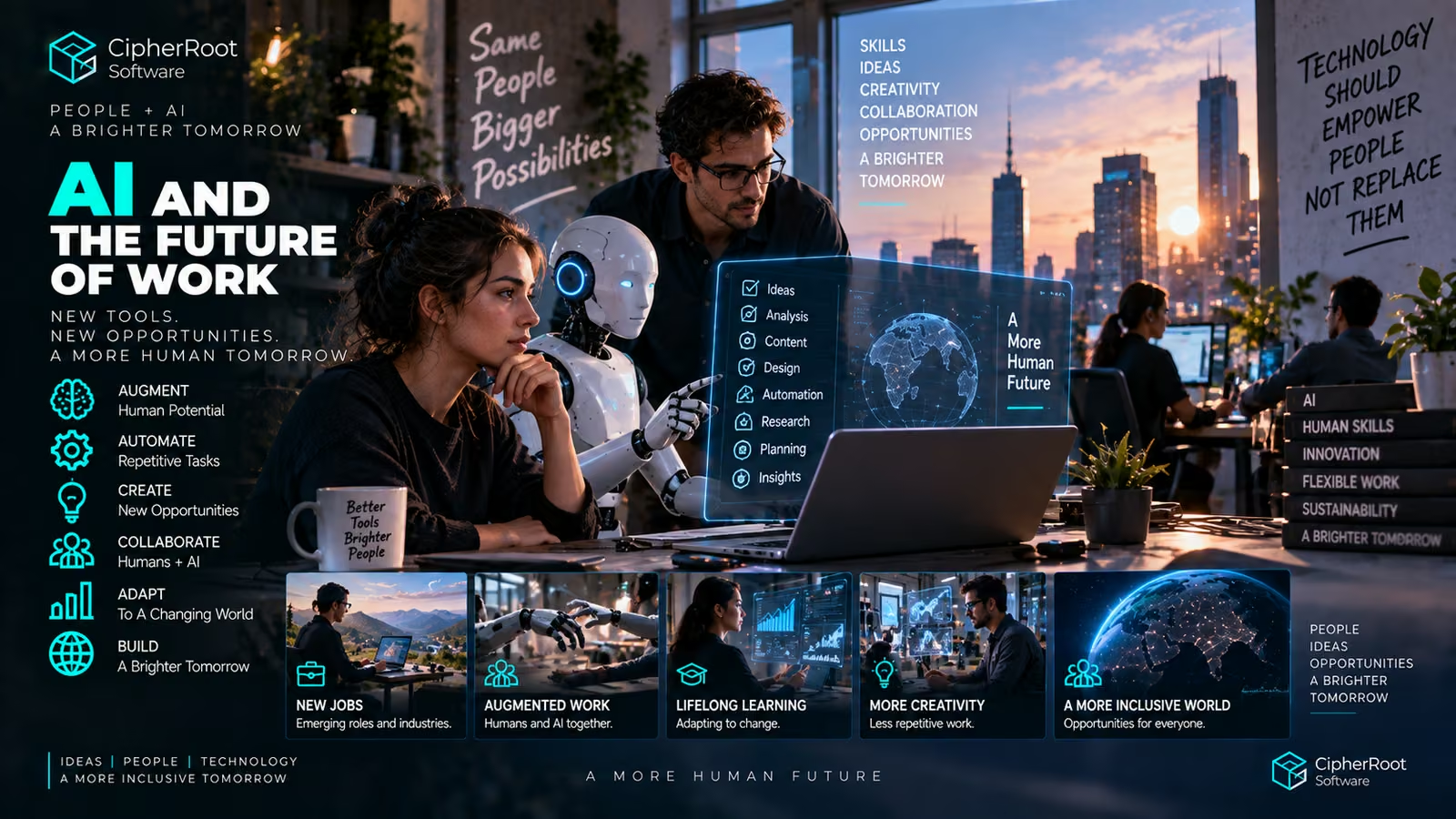
Work Is Entering a New Era
The workplace has changed many times throughout history.
Industrial machinery transformed physical labor.
Computers transformed information processing.
The internet transformed communication and collaboration.
Now artificial intelligence is becoming part of the next major transformation.
AI can write, analyze, summarize, generate images, process information, automate workflows, and assist with increasingly complex tasks.
This raises an important question:
What will work look like when intelligent software becomes part of everyday business?
The answer is unlikely to be a simple world where machines replace everyone.
A more realistic future is one where humans and AI work together, with each contributing different strengths.
What Is AI Changing at Work?
Artificial intelligence can already assist with many activities that once required significant amounts of manual effort.
These activities can include:
- Data analysis
- Document processing
- Customer support
- Content creation
- Scheduling
- Research
- Software development
- Translation
- Administrative tasks
- Business reporting
AI is particularly useful for repetitive, information-heavy tasks.
This allows employees to spend more time on activities that require context, communication, creativity, and judgment.
The result is not necessarily fewer tasks.
It can mean different tasks.
Automation Is the Beginning
Automation is one of the most obvious effects of AI.
A repetitive workflow can often be converted into a sequence of automated actions.
For example, an AI-powered business system could receive a customer message, classify the request, search internal documentation, prepare a response, and send the case to an employee when human intervention is required.
The machine handles the repetitive steps.
The employee handles the exceptions.
This model can make organizations faster without removing human responsibility from every process.
AI Assistants Will Become Everyday Tools
The future workplace may contain AI assistants in almost every major software application.
Email systems may help write and organize messages.
Project-management platforms may summarize progress.
Customer-management systems may analyze conversations.
Analytics tools may explain business data in natural language.
Development environments may help programmers write and review code.
Instead of opening a separate AI application, employees may simply use software that already contains AI capabilities.
AI becomes part of the workflow.
It stops feeling like an additional tool and starts feeling like part of the workplace itself.
Human-AI Collaboration
The most interesting future may not be human versus machine.
It may be human plus machine.
Humans are generally better suited to understanding goals, handling ambiguity, communicating, creating new ideas, and making decisions that depend on context.
AI is particularly powerful at processing large amounts of information, recognizing patterns, generating drafts, and performing repetitive operations quickly.
Combining these capabilities creates a different kind of productivity.
A designer can use AI to generate variations.
A developer can use AI to explore implementation ideas.
A marketer can use AI to analyze customer feedback.
A researcher can use AI to organize large amounts of information.
The human remains responsible for deciding what is useful.
Creativity Will Change, Not Disappear
One common concern is that AI-generated content will eliminate human creativity.
A different possibility is that AI will change the creative process.
Artists can generate concepts faster.
Writers can explore alternative structures.
Designers can test visual directions.
Filmmakers can create early prototypes.
Musicians can experiment with new arrangements.
The limiting factor may increasingly become less about producing an idea and more about choosing the right idea.
When generating ten concepts becomes easy, understanding which concept deserves development becomes more important.
Human taste, judgment, experience, and originality therefore remain valuable.
The Rise of New Jobs
Technology often changes job categories rather than simply removing them.
As AI becomes more common, organizations may need people who can manage, supervise, integrate, and improve intelligent systems.
New roles can emerge around:
- AI operations
- AI system integration
- Model evaluation
- Data governance
- AI security
- Workflow automation
- Human-AI interaction
- AI product management
- Responsible AI
The exact job titles will continue to change.
The broader trend is toward workers who understand both their professional field and the capabilities and limitations of AI systems.
AI Literacy Will Become a Basic Skill
In the future workplace, knowing how to use AI may become as normal as knowing how to use email or spreadsheets.
Employees may need to understand:
What should AI handle?
What should a human review?
How can AI outputs be verified?
Which information should never be shared with an AI system?
How should AI tools be integrated into existing workflows?
These are not purely technical questions.
They are workplace skills.
AI literacy may therefore become increasingly valuable across many professions.
The Importance of Critical Thinking
AI can produce impressive answers.
That does not mean every answer is correct.
AI systems can misunderstand questions, generate unsupported claims, miss important context, or confidently produce incorrect information.
Workers therefore need to remain critical.
The future workplace will require people who can:
- Verify information
- Question assumptions
- Recognize errors
- Compare sources
- Identify missing context
- Make informed decisions
AI can accelerate information processing.
Human judgment remains necessary for deciding what the information actually means.
The Workplace Becomes More Data-Driven
Modern organizations generate enormous amounts of information.
Sales data.
Customer messages.
Operational records.
Financial information.
Project activity.
Website analytics.
AI can help employees understand this information faster.
Instead of reviewing hundreds of pages of reports, a manager might ask a system to identify important changes and explain the major patterns.
This could make data more accessible to employees who are not specialized analysts.
The value comes from turning complex information into something understandable and actionable.
Remote and Hybrid Work
AI can also influence how distributed teams work.
Meetings can be summarized automatically.
Tasks can be extracted from conversations.
Documents can be translated.
Project updates can be organized.
Knowledge can be retrieved through internal AI assistants.
This can reduce some of the friction created by distributed collaboration.
A future employee may not need to search through dozens of old documents to find a decision made months earlier.
An AI system could potentially retrieve the relevant context.
The AI-Powered Small Team
One of the biggest consequences of AI could be increasing the capabilities of small teams.
A small company can use AI for marketing, customer support, analytics, administration, design, and development without building a large department for each activity.
This can create operational leverage.
A small group of people may be able to manage workflows that previously required many specialized roles.
The advantage does not come from AI working alone.
It comes from people being able to use AI across multiple parts of the business.
AI Agents and Autonomous Workflows
The next stage is moving from assistants to agents.
A traditional AI assistant responds to a request.
An AI agent can potentially complete a sequence of related tasks.
For example, a business agent might:
1. Receive a request. 2. Understand the objective. 3. Gather relevant information. 4. Use connected software. 5. Complete routine actions. 6. Report the result. 7. Escalate unusual cases to a human.
This creates a new form of software automation.
The application is no longer simply helping someone do the work.
It is performing part of the workflow itself.
As agentic systems become more capable, permission management and human oversight become increasingly important.
Jobs Will Become More Human in Some Ways
It may seem strange, but increasing automation could make certain jobs more focused on human abilities.
When machines handle repetitive work, employees can spend more time on:
- Communication
- Leadership
- Creativity
- Negotiation
- Relationship building
- Strategic planning
- Problem solving
A customer-service employee may spend less time answering identical questions and more time solving unusual customer problems.
A software engineer may spend less time writing repetitive code and more time designing architecture.
A manager may spend less time preparing reports and more time making decisions.
Automation can remove repetitive work.
It does not automatically remove meaningful work.
The Need for Continuous Learning
Technology moves quickly.
Skills that are valuable today may change as tools improve.
Workers will therefore need to keep learning.
This does not mean everyone needs to become a programmer.
A designer needs to understand AI-assisted design.
A marketer needs to understand AI-powered content and analytics.
A manager needs to understand AI workflows and governance.
A developer needs to understand how AI changes software development.
Continuous learning may become a normal part of professional life.
Privacy and Security at Work
AI systems often need access to business information to be useful.
That creates security concerns.
Employees may work with:
- Customer data
- Financial records
- Contracts
- Internal documents
- Product information
- Company strategies
Organizations need clear policies governing how AI tools can access and process this information.
Businesses may also need:
- Access controls
- Data classification
- Secure integrations
- Activity monitoring
- Identity management
- Clear employee guidelines
The more capable workplace AI becomes, the more important data governance becomes.
Trust and Transparency
Employees are more likely to use AI effectively when they understand what it does.
Organizations should be clear about where AI is being used, what information it processes, and where human review is required.
Workers also need to understand the limits of automation.
A system should not be treated as correct simply because it produced a confident answer.
Trust should come from reliable processes, testing, transparency, and accountability.
AI and Management
Managers will also need to adapt.
In an AI-enabled workplace, measuring productivity may become more complicated.
Traditional metrics such as hours worked may become less useful when software can automate large portions of a workflow.
Organizations may increasingly focus on outcomes:
What was created?
What problems were solved?
How quickly did the team respond?
How much value was delivered?
AI may therefore change not only employee workflows but also the way companies think about productivity itself.
The Future Office May Be Smaller but Smarter
The office of the future may contain fewer traditional workstations and more shared digital infrastructure.
Employees could move between physical and virtual environments more freely.
AI assistants could provide information wherever work happens.
Robotic systems could handle physical tasks.
Connected devices could provide real-time information about the workplace.
Digital twins could represent offices, factories, or other physical environments.
The boundary between the digital workplace and the physical workplace could become increasingly blurred.
What Skills Will Matter Most?
As AI becomes more capable, certain human skills may become even more important.
Curiosity.
Critical thinking.
Communication.
Creativity.
Leadership.
Adaptability.
Domain expertise.
The ability to ask good questions may also become surprisingly important.
AI can generate many answers.
Knowing which question to ask can determine whether those answers are useful.
The Future of Work Is Not Just About AI
Artificial intelligence is only one part of a much larger transformation.
Robotics is changing physical work.
Automation is changing business processes.
Cloud computing is changing infrastructure.
Remote collaboration is changing organizational structures.
AI is connecting many of these technologies.
This means the future workplace will likely be shaped by an entire ecosystem rather than one specific technology.
A Day at Work in the Future
Imagine starting your workday with an AI assistant that summarizes what changed overnight.
Your meetings are automatically organized.
Your project dashboard identifies potential delays.
A customer requests information, and the system prepares a response.
You review it, make several changes, and approve it.
Later, an AI agent prepares a report using information from multiple internal systems.
A robot handles part of the physical operation.
You spend the rest of the day working with colleagues on a problem that requires creativity and judgment.
The machines handle speed and scale.
The humans handle meaning.
That may be one of the defining characteristics of future work.
Conclusion
Artificial intelligence is changing the workplace by automating repetitive tasks, accelerating information processing, supporting creativity, and enabling new forms of collaboration.
But the most important transformation may be cultural rather than technical.
Companies will need to rethink how work is organized.
Employees will need to develop new skills.
Managers will need to rethink productivity.
Organizations will need stronger approaches to privacy, security, governance, and trust.
The future of work is unlikely to be a simple story of humans being replaced by machines.
It is more likely to be a story of humans working with increasingly capable machines.
AI can handle more of the repetitive work.
People can focus more on the work that requires judgment, creativity, communication, and purpose.
The tools will continue to evolve.
So will the people using them.
Smarter tools. New skills. Human creativity. A new future of work.