
AI & Machine Learning
AI and Human Language: How Artificial Intelligence Is Changing the Way We Communicate
CipherRoot Software12 min read
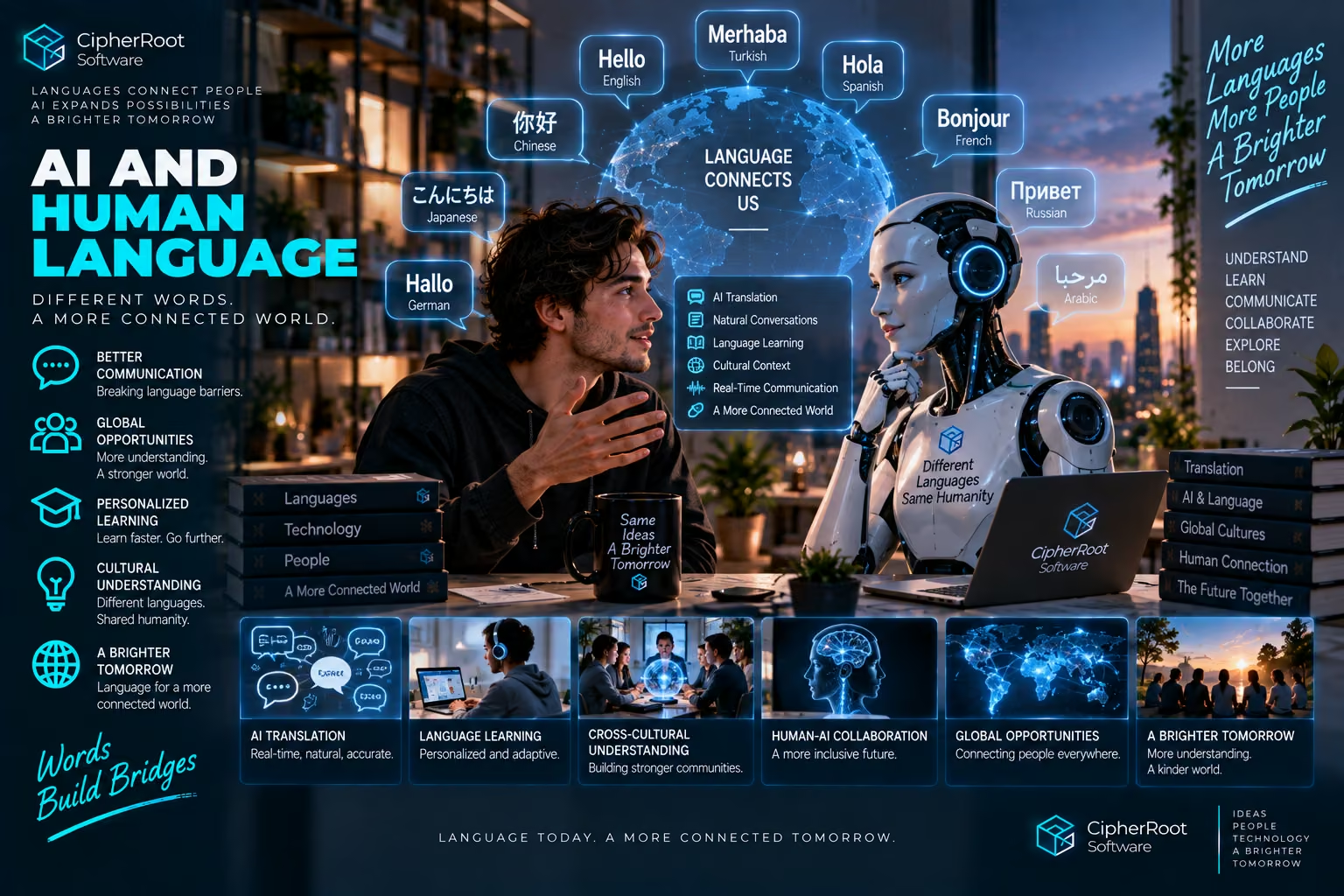
Language Is Becoming a New Interface
Language is one of the oldest technologies humans have ever created.
We use words to share ideas, teach, negotiate, tell stories, build relationships, and understand the world around us.
For thousands of years, communication depended on physical proximity and shared languages.
Technology has changed that.
Writing allowed ideas to travel across generations.
The printing press allowed information to reach millions of people.
The telephone connected distant voices.
The internet connected billions of people.
Now artificial intelligence is changing language itself.
AI systems can understand text, recognize speech, translate languages, summarize information, generate responses, and increasingly interact through natural conversation.
The result is a new kind of human-computer interaction:
Talking to technology instead of simply operating it.
What Is Natural Language AI?
Natural language AI refers to technologies that allow computers to process and work with human language.
This field includes:
Natural language processing Speech recognition Machine translation Text generation Sentiment analysis Information extraction Conversational AI Multimodal AI
These technologies allow software to interpret and generate language in increasingly sophisticated ways.
Instead of requiring users to learn rigid commands, systems can understand requests expressed in ordinary language.
From Commands to Conversations
Traditional software often expects users to interact through buttons, menus, and predefined inputs.
For example:
Click → Select → Search → Confirm
Conversational AI allows another model:
Ask → Understand → Respond
A user can describe what they need in their own words.
An AI assistant can then interpret the request and generate an appropriate response.
This does not eliminate traditional interfaces.
It adds another layer.
Language becomes an interface.
How AI Understands Human Language
Human language is complicated.
The same sentence can mean different things depending on context.
Words can have multiple meanings.
People use slang, accents, abbreviations, humor, and cultural references.
AI language systems are designed to recognize patterns within very large collections of language data.
Modern language models can learn relationships between words, phrases, concepts, and contexts.
They can then use those learned patterns to generate or interpret language.
This is why modern AI can do more than simple keyword matching.
It can work with context.
AI Translation
Translation is one of the most obvious applications of language AI.
Traditional translation systems relied heavily on predefined rules and statistical methods.
Modern AI-based translation systems can use neural networks to model relationships between languages.
This can improve the ability to translate:
Text Speech Websites Documents Conversations
The most exciting possibility is real-time translation.
Imagine two people speaking different languages while an AI system translates the conversation almost immediately.
The technology does not eliminate language differences.
It can make those differences easier to navigate.
Real-Time Speech Translation
Speech introduces an additional challenge because spoken language is not perfectly clean.
People speak quickly.
They pause.
They change topics.
Background noise can interfere.
Accents differ.
AI systems can combine speech recognition, language understanding, translation, and speech synthesis to create near-real-time translation workflows.
The pipeline can look like:
Speech → Recognition → Translation → Synthesized Speech
This could be useful for:
Travel International business Education Customer support Conferences Cross-border collaboration Smart Glasses and Language
Wearable technology could make translation even more natural.
Smart glasses can potentially display translated text or provide audio translation through connected earbuds.
A traveler could look at a sign and receive an explanation.
A person could speak with someone who uses another language and hear a translated version.
AI becomes part of the surrounding environment.
This is one reason wearable computing and language AI are increasingly connected.
AI and Language Learning
AI can also become a personalized language tutor.
A language-learning assistant can potentially adapt to the user's current ability.
It can provide:
Vocabulary practice Grammar explanations Pronunciation exercises Conversation simulations Writing corrections Personalized lessons
Unlike a traditional lesson that follows exactly the same structure for everyone, AI can potentially adapt the interaction to the learner.
A beginner can receive simpler explanations.
An advanced learner can practice more complex conversations.
Conversational Practice
Speaking practice is often one of the most difficult aspects of learning a new language.
AI can provide an environment where learners can practice without waiting for another person.
A learner can simulate:
A restaurant conversation
A job interview
A business meeting
A travel situation
A casual conversation
This can reduce the pressure of making mistakes in front of other people.
Mistakes become part of the learning process.
AI and Pronunciation
Speech technologies can analyze spoken language and compare it with expected pronunciation patterns.
AI-assisted language systems can potentially identify areas where a learner's pronunciation differs from the target language.
The system can then provide feedback.
This creates a more interactive learning loop:
Speak → Analyze → Correct → Repeat
The technology does not replace language teachers.
It can provide additional practice between lessons.
Accessibility and Communication
AI language technology can also improve accessibility.
Speech recognition can convert spoken words into text.
Text-to-speech can convert written content into audio.
Translation can help users communicate across language barriers.
Automatic captioning can improve access to spoken content.
These applications can make digital information available through multiple forms of communication.
This is particularly important because people interact with technology in different ways.
AI for People Who Cannot Speak
Assistive communication technologies are exploring ways for people with speech difficulties to communicate through alternative interfaces.
AI can assist with predicting intended words, generating speech from text, and adapting communication systems to individual users.
The goal is not to imitate every aspect of normal speech.
It is to give people more ways to express themselves.
Communication is a fundamental human capability.
Technology can help create additional channels.
AI and Sign Language
AI is also being explored for sign-language recognition and translation.
Computer-vision systems can analyze hand movements, gestures, and facial expressions.
The challenge is significant because sign languages are not simply hand gestures.
They contain grammar, context, facial expressions, and cultural differences.
Any useful system therefore needs to model more than individual hand shapes.
This remains an active research area.
Understanding Context
Words alone are not enough.
Consider the sentence:
“That's cold.”
It could refer to temperature.
It could describe food.
It could be a comment about someone's behavior.
It could even be a joke.
Human communication depends heavily on context.
Advanced AI models attempt to use surrounding information to interpret meaning more accurately.
The better AI becomes at context, the more natural interactions can become.
Multimodal Language AI
Human communication is not limited to words.
We communicate through:
Text Speech Facial expressions Images Gestures Tone Physical context
Multimodal AI attempts to work across multiple kinds of information.
A user might show an image and ask a question about it.
A wearable system might combine voice with visual information.
A robot might interpret spoken language alongside its surroundings.
This creates a more complete communication loop.
AI and Human Emotion
Language also contains emotion.
People can sound excited, frustrated, confused, sarcastic, or uncertain.
AI systems are being developed to identify some emotional cues in language and speech.
This can help systems respond more appropriately in certain contexts.
However, emotion recognition remains imperfect.
Human emotion is complicated, and software should not be assumed to understand someone's emotional state with certainty.
It can identify signals.
It cannot automatically know exactly what a person feels.
Cultural Context Matters
Translation is more than replacing one word with another.
Languages carry culture.
A phrase that sounds normal in one language may sound strange or even offensive in another.
Humor can be especially difficult to translate.
Idioms may have no direct equivalent.
AI systems therefore need cultural context in addition to vocabulary.
This is one reason human review can remain valuable for important communication.
AI and Global Collaboration
Global teams increasingly work across languages and time zones.
AI can help reduce communication friction.
Meeting systems can provide live transcription.
Documents can be translated automatically.
Messages can be localized.
Employees can ask AI to explain unfamiliar terminology.
This can make international collaboration easier.
The technology becomes a bridge between language communities.
AI in Customer Support
Businesses can also use language AI to improve customer support.
AI assistants can help answer common questions across multiple languages.
They can translate incoming messages.
They can summarize customer interactions.
They can route complex cases to human representatives.
A multilingual support system can potentially help smaller businesses serve customers internationally without creating a separate support department for every language.
AI and Content Localization
Creating content for a global audience traditionally requires translation and localization.
AI can assist with:
Website translation Subtitle creation Voice dubbing Product descriptions Marketing copy Documentation
But translation alone does not always create good localization.
Words may be correct while the cultural tone is wrong.
Human review remains especially valuable for important brand communication.
Voice Assistants Are Changing
Early voice assistants relied heavily on fixed commands.
Users had to know what phrases the system recognized.
Modern language models allow more flexible interaction.
People can speak naturally.
They can ask follow-up questions.
They can clarify previous requests.
They can change the subject.
This creates a more conversational experience.
The assistant feels less like a voice-operated menu and more like a language-based interface.
AI and Human Creativity
Language AI is also becoming a creative tool.
Writers can use AI to brainstorm.
Filmmakers can develop dialogue.
Game developers can create character conversations.
Marketers can explore messaging concepts.
Students can experiment with writing styles.
The AI can generate possibilities.
The human decides which possibilities have value.
This creates another form of human-AI collaboration.
The Risk of Generic Language
As AI-generated communication becomes common, there is a risk of everything sounding similar.
Professional emails may begin to use the same phrases.
Marketing copy may follow similar patterns.
Social posts may lose personality.
This makes authentic human voice more valuable.
AI can help with clarity.
People still provide identity.
AI Can Generate Language Without Understanding It Like a Human
An important distinction should remain clear.
AI systems can generate remarkably coherent language.
That does not automatically mean they understand the world in the same way humans do.
They operate through learned patterns and computational representations.
They can produce explanations that sound confident even when they are incorrect.
This is why users should distinguish between fluent language and verified knowledge.
They are not the same thing.
Hallucinations and Accuracy
Language models can sometimes generate information that is incorrect but appears plausible.
This is often called a hallucination.
For casual creative tasks, this may be relatively harmless.
For areas such as medicine, law, finance, science, or technical safety, incorrect information can be much more serious.
AI-generated information therefore needs appropriate verification.
The more important the subject, the more important independent checking becomes.
Privacy and Language Data
Language AI often processes highly personal information.
A conversation may contain:
Personal details Business information Private communications Sensitive documents
Users and organizations should therefore understand where their information is processed and how it is stored.
Privacy should be part of the design of language systems.
The more personal the assistant becomes, the more important data protection becomes.
AI and the Future of Writing
Writing may become more interactive.
Instead of opening a blank document, a writer might begin by explaining an idea to an AI assistant.
The system can help structure it.
The writer revises the argument.
AI suggests alternatives.
The writer rejects most of them.
A final version emerges through collaboration.
The role of the writer shifts from typing every sentence manually to directing language and meaning.
AI and the Future of Conversation
The long-term goal of conversational AI is not simply to answer questions.
It is to maintain context across an interaction.
A future AI assistant may remember the current project, understand previous decisions, and adapt its communication style to the situation.
This could make digital interactions far more natural.
But memory also creates privacy questions.
A system that remembers more can be more useful.
It can also become more sensitive.
Language and Robotics
Language becomes especially interesting when AI controls physical machines.
A person could tell a service robot:
“Please bring that box over here.”
The robot needs to understand:
Which box?
Where is “here”?
Is the box safe to move?
What path should it take?
This requires language understanding to connect with computer vision, navigation, and physical action.
The robot is not simply generating a sentence.
It is turning language into behavior.
AI and Humanoid Robots
Humanoid robots may eventually use conversational AI as their primary interface.
Instead of learning a complex control system, people could communicate naturally.
You speak.
The robot interprets.
It plans.
It acts.
This creates a much more accessible form of human-robot interaction.
The challenge is making sure that the robot understands limitations and does not confidently act on ambiguous instructions.
Language as a Universal Interface
One of the most significant long-term possibilities is that natural language becomes a universal interface for digital systems.
A user could say:
“Create a website for this idea.”
“Analyze these sales numbers.”
“Translate this conversation.”
“Organize my files.”
“Design a prototype.”
The underlying software could be extremely complex.
The interface becomes simple:
Human language.
This could lower the barrier to using advanced technology.
The Future of Multilingual AI
Future AI systems may increasingly operate across many languages simultaneously.
A user could write in one language.
Another person could respond in another.
The AI could preserve meaning and context between them.
This could support:
International education Global business Remote teams Tourism Research Online communities
Language would remain diverse.
Communication would become easier across that diversity.
The Human Element Will Remain
Technology can process words.
But language is also about identity.
Culture.
Memory.
Humor.
Emotion.
History.
Relationships.
A perfect translation can still miss a cultural nuance.
A grammatically correct sentence can still sound cold.
A technically correct response can still be inappropriate.
Human communication is richer than syntax.
AI can assist with language.
Humans give language its meaning.
Conclusion
Artificial intelligence is changing the way humans interact with language.
Translation is becoming faster.
Voice interfaces are becoming more natural.
Language learning is becoming more personalized.
Accessibility tools are expanding.
Global communication is becoming easier.
Robots may eventually understand spoken instructions and act on them.
At the same time, important challenges remain.
AI can make mistakes.
Context can be misunderstood.
Cultural nuances can be lost.
Privacy can be compromised.
Fluent language does not guarantee factual accuracy.
The future of language AI will therefore depend on combining machine capability with human judgment.
AI can translate words.
It can recognize patterns.
It can generate responses.
But communication is about more than words.
It is about understanding people.
And the most powerful future may be one where AI helps people understand one another without erasing the languages, cultures, and identities that make communication meaningful.
More languages. Fewer barriers. Deeper connections.
Technology can build the bridge.
Humans still decide where the bridge should lead.