
AI & Machine Learning
AI and Human Collaboration: Building a Stronger Future Together
CipherRoot Software9 min read
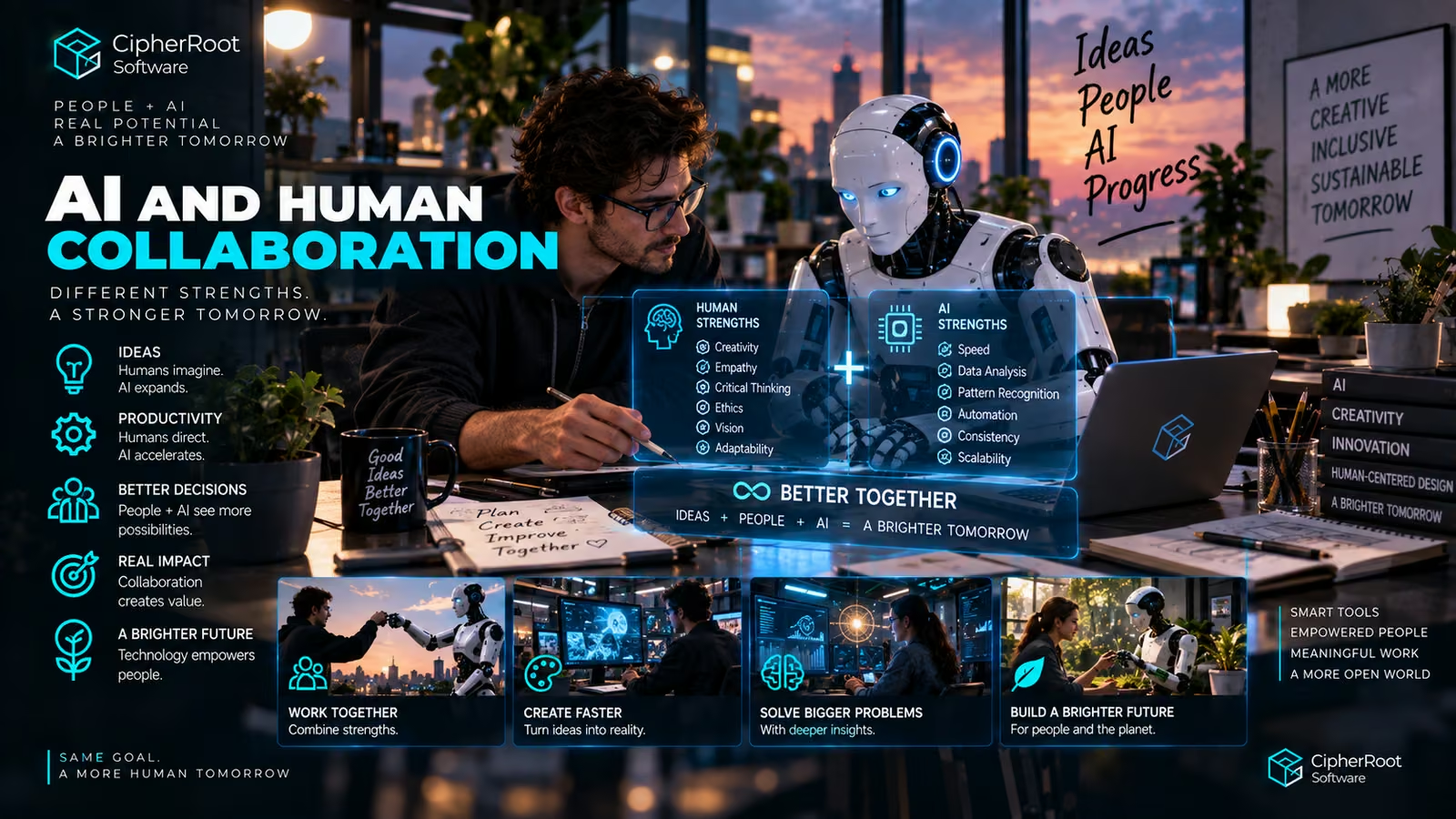
Humans and AI Are Entering the Same Workspace
For decades, technology has been designed to help people work faster.
Computers can calculate enormous amounts of information.
Software can automate repetitive processes.
Robots can perform precise physical tasks.
Artificial intelligence adds another dimension.
AI can analyze information, recognize patterns, generate content, summarize complex material, and assist with decisions.
This creates a new question for the modern workplace:
What happens when humans and AI work together continuously?
The answer may not be a future where machines replace humans.
It may be a future where people use intelligent systems as collaborative tools.
The strongest results can come from combining different strengths.
Human creativity + machine intelligence.
What Does AI and Human Collaboration Mean?
AI and human collaboration means designing workflows in which people and AI systems contribute to the same objective.
The AI may handle tasks such as:
- Data analysis
- Pattern recognition
- Information retrieval
- Draft generation
- Repetitive processing
- Automation
- Large-scale comparison
Humans may focus on:
- Creativity
- Context
- Judgment
- Communication
- Ethics
- Strategy
- Decision-making
The exact division depends on the task.
The important idea is that AI does not need to perform the entire job to be valuable.
Sometimes it only needs to remove the most repetitive part.
Different Strengths, One Goal
Human intelligence and artificial intelligence have different characteristics.
AI can process information at a scale that would be difficult for one person.
Humans can understand social context, personal experience, values, and ambiguous situations in ways that software may struggle to reproduce.
This makes collaboration interesting.
A designer can use AI to generate many visual concepts quickly and then select and refine the most appropriate direction.
A researcher can use AI to organize large quantities of information while personally evaluating the evidence.
A developer can use AI to explore implementation options while remaining responsible for architecture and testing.
The machine expands the possibilities.
The human decides what matters.
AI as a Creative Partner
Creativity is often associated with uniquely human work.
But AI can become a useful creative partner without becoming the creator of everything.
A writer might ask AI for alternative structures.
A filmmaker might explore different scene concepts.
A designer might generate multiple visual directions.
A musician might experiment with arrangements or sound ideas.
The human can then combine, reject, modify, and develop those outputs.
This changes the creative workflow.
Instead of starting from a blank page every time, creators can begin with a set of possibilities and spend more time shaping the final result.
The important skill becomes not simply generating ideas.
It becomes knowing which ideas are worth pursuing.
Faster Research and Better Information Access
Research can consume a large amount of time.
People often need to search documents, compare information, summarize reports, and organize findings before they can begin solving the actual problem.
AI can assist with these preparatory steps.
For example, an AI research assistant could help:
- Summarize long documents
- Extract key points
- Organize notes
- Compare information
- Find related topics
- Create initial research structures
The human remains responsible for checking important information and understanding the context.
This creates a useful division of labor.
AI processes information. Humans interpret it.
AI and Software Development
Software development is another area where collaboration is becoming increasingly important.
AI tools can assist developers with:
- Code generation
- Refactoring
- Debugging
- Documentation
- Test generation
- Code explanation
- Project exploration
A developer can describe a problem and receive a possible implementation.
But generated code still needs to be reviewed, tested, secured, and integrated into the larger architecture.
The developer's role becomes less about writing every line manually and more about understanding systems, defining requirements, evaluating solutions, and maintaining quality.
AI can accelerate development.
It does not remove the need for engineering.
Human Judgment Remains Critical
AI systems can produce convincing answers even when those answers are incorrect.
This makes human judgment especially important.
People need to ask:
Is the information accurate?
Does it fit the situation?
What assumptions does the system make?
What information is missing?
What happens if the recommendation is wrong?
The stronger the consequences of a decision, the more important human oversight becomes.
A useful collaboration model is therefore not blind trust.
It is AI assistance combined with human verification.
AI and Decision Support
AI can help organizations analyze complex situations.
A business may have thousands of sales records.
A manufacturing company may have enormous quantities of machine data.
A logistics company may manage constantly changing routes.
AI can detect patterns and provide recommendations.
But decision support is different from decision ownership.
The system can show possibilities.
Humans can evaluate the consequences.
This distinction is especially important when decisions involve customers, employees, finances, safety, or other high-impact areas.
The Future Workplace Will Be Hybrid
The workplace of the future is likely to contain a mixture of:
Humans
AI assistants
AI agents
Robots
Automated workflows
Connected software
These technologies will not necessarily operate independently.
They may form one integrated workflow.
An employee could ask an AI assistant to analyze information.
The AI agent could retrieve data from several systems.
A robot could perform a physical task.
The employee could review the result and make the final decision.
This creates a hybrid workplace where digital and physical systems work together.
AI Agents and Collaborative Workflows
Traditional software waits for a command.
AI agents can potentially manage multi-step tasks.
For example, an AI agent could receive a business request, gather the required information, prepare a draft, update an approved system, and ask a human to review the final action.
This creates a new form of collaboration.
The human sets the objective.
The agent performs a defined sequence of actions.
The human supervises the outcome.
The system can then repeat the workflow when similar requests appear.
The challenge is making sure agents operate within clear boundaries.
Permissions, security controls, activity logs, and human approval mechanisms become increasingly important as AI systems gain more autonomy.
AI in Design and Media
Creative industries can benefit greatly from human-AI collaboration.
Graphic designers can use AI for concept exploration.
Video editors can automate repetitive processing.
Photographers can accelerate image organization.
3D artists can prototype environments.
Writers can experiment with story structures.
AI can reduce the time spent on mechanical tasks.
Human creators can spend more time on storytelling, visual identity, emotional impact, and artistic direction.
This is especially valuable in fields where the final quality depends heavily on taste and creative judgment.
Human Creativity Becomes More Valuable
There is an interesting paradox.
The more AI can generate, the more valuable human taste may become.
If creating ten concepts is easy, choosing one becomes more important.
If generating hundreds of images is easy, visual direction becomes more important.
If producing multiple written drafts is easy, having something meaningful to say becomes more important.
AI can increase the volume of possibilities.
Humans determine which possibilities deserve attention.
AI and Education
Education could also become more collaborative.
Students may use AI tutors to explore difficult concepts, practice languages, generate exercises, or receive explanations at different levels of complexity.
Teachers can spend more time on:
- Guidance
- Mentoring
- Classroom interaction
- Motivation
- Evaluation
- Human connection
AI can support learning, but education is not only information delivery.
Understanding, curiosity, communication, and human encouragement remain important.
The technology should therefore support educators and learners rather than reduce education to automated answers.
Collaboration in Manufacturing
The relationship between humans and AI becomes even more physical in manufacturing.
Robots can perform repetitive assembly.
Computer vision can inspect products.
AI can monitor production systems.
Autonomous machines can move materials.
Human engineers can supervise processes, solve unusual problems, improve workflows, and maintain equipment.
This creates a factory where humans are not simply standing outside an automated system.
They are part of an interconnected production environment.
Collaboration and Accessibility
AI-human collaboration can also make technology more accessible.
Voice interfaces can provide an alternative to keyboard-based interaction.
AI can help convert complex information into simpler explanations.
Translation tools can assist communication across languages.
Vision systems can provide additional information about physical environments.
These applications demonstrate an important principle:
Technology is most valuable when it helps more people participate.
Trust Must Be Designed
Successful collaboration requires trust.
People need to understand what the AI can do.
They also need to understand what it cannot do.
A system that hides its limitations can create false confidence.
A system that clearly communicates uncertainty can support better decision-making.
Transparency therefore matters.
Users should know when AI is being used, what information it has access to, and when a human needs to intervene.
Privacy and Data Protection
AI systems often require access to information.
In workplaces, that information may include sensitive documents, customer records, internal conversations, or intellectual property.
This makes data protection essential.
Organizations need clear policies around:
- What data AI can access
- Where information is processed
- How long it is stored
- Who can use it
- Which actions require approval
- How systems are monitored
A collaborative AI system should help people without quietly turning every workplace interaction into a data-collection process.
AI Should Expand Human Capability
One of the most useful ways to think about AI is as a capability multiplier.
A skilled person can often accomplish more with effective tools.
A designer with better software can explore more ideas.
A programmer with better development tools can build faster.
A researcher with better information systems can examine more evidence.
AI can become part of that toolkit.
The goal is not simply to make people work faster.
It is to help them work at a higher level.
The Skills of the Future
As AI becomes part of everyday work, technical knowledge alone will not be enough.
Workers may also need:
Critical thinking
The ability to question AI-generated information.
Communication
The ability to express goals clearly to both people and machines.
Domain expertise
Understanding the real-world problem being solved.
Creativity
Generating original ideas and combining perspectives.
Adaptability
Learning new tools as technology changes.
AI literacy
Understanding how AI systems work and where their limitations lie.
These skills complement AI rather than compete with it.
Measuring Collaboration
Organizations should evaluate AI-human collaboration by outcomes.
Useful questions include:
Did the workflow become faster?
Did quality improve?
Did errors decrease?
Did employees spend more time on meaningful tasks?
Did customers receive better service?
Did the organization make better-informed decisions?
These questions are more useful than simply counting how much AI is being used.
Technology adoption is not the goal.
Better work is.
The Future of Work Is a Team of Many Kinds
The concept of a team is expanding.
A future project team might include:
A human manager.
A designer.
A software engineer.