
AI & Machine Learning
AI and Climate Change: How Artificial Intelligence Could Help Build a Greener Future
CipherRoot Software7 min read
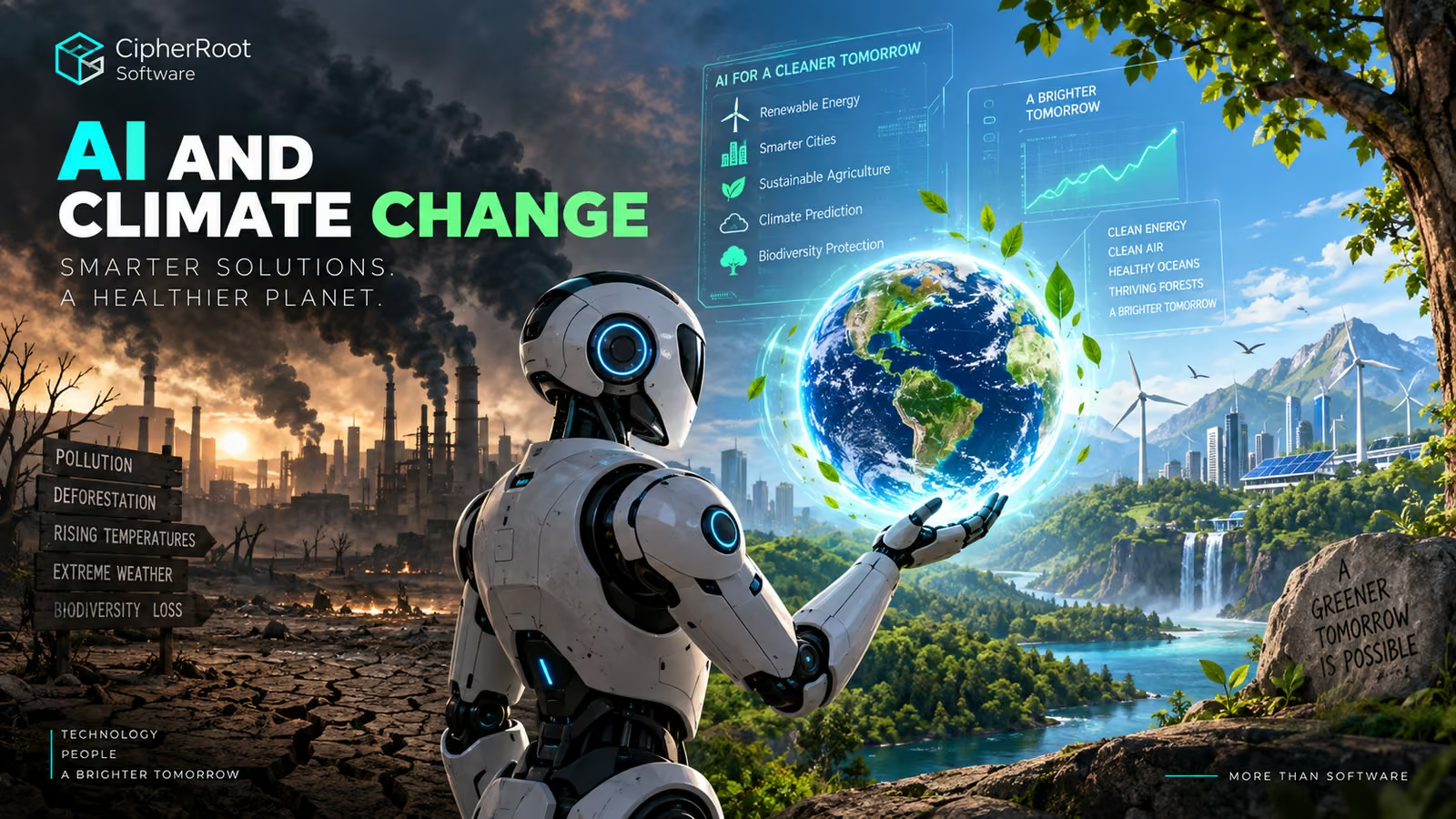
Artificial Intelligence Meets the Climate Challenge
Climate change is one of the most complex challenges facing the modern world. Rising temperatures, extreme weather, ecosystem disruption, resource shortages, and increasing energy demand are creating problems that cannot be solved with a single technology.
At the same time, artificial intelligence is rapidly becoming one of the most powerful tools in modern computing.
AI can analyze enormous amounts of information, identify patterns, optimize complex systems, and make predictions based on data. These capabilities could make artificial intelligence an important part of future efforts to understand and respond to climate change.
The real question is not whether AI can solve climate change by itself.
It cannot.
The more important question is how AI can help people make better decisions, use resources more efficiently, and build smarter systems.
How AI Can Help Fight Climate Change
Artificial intelligence can contribute to environmental efforts in several different areas.
From energy production and transportation to agriculture and conservation, AI systems can process data that would be difficult for humans to analyze manually.
Machine learning models can examine information from sensors, satellites, weather stations, energy networks, and other sources. This allows organizations to identify trends, forecast changes, and optimize operations.
The result could be more efficient systems with less wasted energy and resources.
Smarter Renewable Energy
Renewable energy sources such as solar and wind are highly dependent on environmental conditions.
Cloud cover can affect solar generation. Wind speeds can change quickly. Electricity demand also varies throughout the day.
AI can help operators analyze these variables and improve energy forecasting.
For example, machine learning systems can estimate how much electricity a solar farm or wind farm is likely to produce. Grid operators can then use these forecasts to balance supply and demand more effectively.
AI can also help identify equipment problems before they become serious failures.
This type of predictive maintenance can reduce downtime, extend equipment lifetimes, and improve the efficiency of renewable energy infrastructure.
More Efficient Smart Grids
The electricity grid is becoming increasingly complex.
Homes, electric vehicles, solar panels, batteries, factories, and data centers can all influence energy demand.
AI could help coordinate these systems.
A smart grid supported by machine learning could analyze electricity consumption in real time and identify opportunities to shift demand to periods when energy is more readily available.
For example, certain industrial processes or charging systems could potentially be scheduled during lower-demand periods.
This could help reduce unnecessary pressure on electricity networks.
AI and Climate Prediction
One of the most important applications of artificial intelligence is analyzing environmental data.
Weather and climate systems involve an enormous number of variables. Traditional scientific models remain essential, but AI can provide additional methods for processing complex datasets.
Machine learning can be used to study patterns in:
Temperature changes Rainfall Ocean conditions Atmospheric measurements Wildfire risk Storm development Drought conditions
Better prediction does not prevent extreme weather from happening.
However, improved forecasting can help communities prepare for potential risks and make decisions earlier.
Sustainable Agriculture
Agriculture is closely connected to climate and resource availability.
Farmers need to manage water, soil, fertilizers, crops, pests, and changing weather conditions.
AI-powered agricultural systems can combine sensor data, satellite imagery, weather information, and historical records to help farmers understand field conditions.
A smart farming system could identify areas that require more water while reducing unnecessary irrigation in areas that do not.
Computer vision can also help detect plant diseases or crop problems earlier.
This approach, often described as precision agriculture, can help make farming more targeted rather than treating every part of a field in exactly the same way.
Protecting Forests and Biodiversity
Forests play an important role in ecosystems and carbon cycles, while biodiversity supports healthy natural environments.
AI can assist conservation teams by analyzing satellite images, drone footage, and sensor data.
These technologies can help identify changes in forests, detect suspicious land-use activity, monitor wildlife populations, and track environmental changes over time.
Computer vision can also be used to recognize animal species in camera-trap images.
Instead of requiring humans to manually examine thousands of photographs, AI systems can help filter and categorize large datasets.
This allows researchers to spend more time studying the results and making conservation decisions.
AI Can Help Monitor the Oceans
The world's oceans absorb heat and play a major role in the global climate system.
AI can assist researchers in analyzing large quantities of ocean data collected from satellites, sensors, research vessels, and autonomous systems.
Machine learning can potentially help identify changes in ocean temperature, pollution patterns, marine ecosystems, and other environmental indicators.
Autonomous robotic systems could also use AI to navigate difficult environments while collecting scientific data.
The combination of robotics and artificial intelligence may eventually allow researchers to monitor parts of the ocean that are currently difficult or expensive to study continuously.
Smarter Cities and Transportation
Cities consume large amounts of energy and generate significant levels of traffic and emissions.
AI can help optimize urban systems.
Traffic management systems can analyze vehicle movement and adjust signals dynamically. Public transportation networks can use demand data to improve scheduling. Building management systems can automatically adjust heating, cooling, lighting, and ventilation.
Electric vehicle charging can also become more intelligent.
Instead of charging every vehicle at the same time, AI-powered systems could coordinate charging based on electricity demand, battery requirements, and available energy.
Small improvements across millions of devices could potentially create significant efficiency gains.
The Hidden Cost of Artificial Intelligence
There is an important side to this discussion that should not be ignored.
AI itself requires energy.
Training and operating large computational systems can require substantial amounts of electricity. Data centers also require cooling infrastructure and physical resources.
This creates a paradox.
AI can potentially help reduce emissions and improve efficiency, while the infrastructure required to run AI systems can also consume significant resources.
Therefore, the environmental value of AI depends not only on what the technology can accomplish, but also on how efficiently the technology is built and operated.
More efficient hardware, better software, renewable electricity, improved cooling systems, and responsible computing practices can all become important parts of the equation.
AI Is a Tool, Not a Climate Solution by Itself
It is easy to imagine AI as a futuristic technology that will automatically solve environmental problems.
Reality is more complicated.
Artificial intelligence can provide predictions, recommendations, automation, and optimization. But people and institutions still need to make decisions.
A perfect prediction is useless if nobody acts on it.
A smart energy system is ineffective if the infrastructure around it is poorly designed.
A powerful environmental model cannot replace scientific research, policy, investment, engineering, or international cooperation.
AI should therefore be viewed as a tool that strengthens human capabilities, rather than a replacement for them.
The Future of AI and Sustainability
The relationship between artificial intelligence and climate change is likely to become increasingly important as both technologies continue to develop.
Future AI systems may become more efficient, more specialized, and more integrated with physical infrastructure.
We could see AI working alongside:
Renewable energy systems to improve forecasting and grid management.
Robots to inspect infrastructure and monitor ecosystems.
Satellites to observe environmental changes at a global scale.
Smart cities to reduce energy and resource waste.
Agricultural technology to improve water and crop management.
Scientific computing to accelerate climate and environmental research.
The most interesting developments may happen when these technologies are connected rather than operating independently.
A Smarter Path Forward
Climate change is not a problem that can be solved by one invention.
It requires better information, better infrastructure, responsible policies, scientific research, technological innovation, and long-term cooperation.
Artificial intelligence can contribute by helping us understand complex systems and operate them more efficiently.
Used responsibly, AI could become an important part of a broader technological transition toward cleaner energy, smarter resource management, and better environmental monitoring.
The future may not be about choosing between technology and nature.
It may be about designing technology that works with nature instead of against it.
Conclusion
Artificial intelligence will not solve climate change alone, but it has the potential to become one of the most useful tools for understanding and managing the systems connected to it.
From renewable energy and smart grids to agriculture, conservation, transportation, and climate research, AI can help transform enormous amounts of environmental data into practical information.
The challenge is making sure that the technology itself is developed responsibly.
A greener future will not come simply from building more intelligent machines.
It will come from using those machines wisely.
AI can help us see the patterns. Humans still have to choose what to do with them.